Implied Volatility and Debit Spreads: Trade Setup Guide

📚 The Ultimate Debit Spread Series — Part 6 of 20
- Part 1: What is a Debit Spread? The Ultimate Beginner’s Guide
- Part 2: Call Debit Spreads vs. Put Debit Spreads: Understanding the Core Differences
- Part 3: The Mechanics of a Debit Spread: Max Profit, Max Loss, and Breakeven Explained
- Part 4: Why Trade Debit Spreads Instead of Buying Single Options?
- Part 5: How to Choose the Right Strike Prices and Widths for Your Debit Spreads
- Part 6: Implied Volatility and Debit Spreads: What You Need to Know Before Entering a Trade (you are here)
⚡ Key Takeaways
- Debit spreads are directionally dominant but remain partially sensitive to shifts in implied volatility.
- Vega is mitigated because you buy high-volatility premium and sell lower-volatility premium simultaneously.
- Always enter debit spreads when implied volatility rank is low to maximize your statistical edge.
Many retail traders buy debit spreads thinking they have completely neutralized the devastating effects of implied volatility crush. This is a costly misconception that leads to unexpected losses when volatility collapses after an earnings announcement or major macroeconomic report. Welcome to Part 6 of our series, where we expose exactly how volatility impacts your spreads and how to use it to your advantage.
The Myth of the Volatility-Proof Debit Spread
A debit spread involves buying an option and selling another option further out-of-the-money, a structure we analyzed during our look at strike selection in Part 5. Because you are simultaneously long and short volatility, many educators falsely claim that debit spreads are immune to volatility fluctuations.
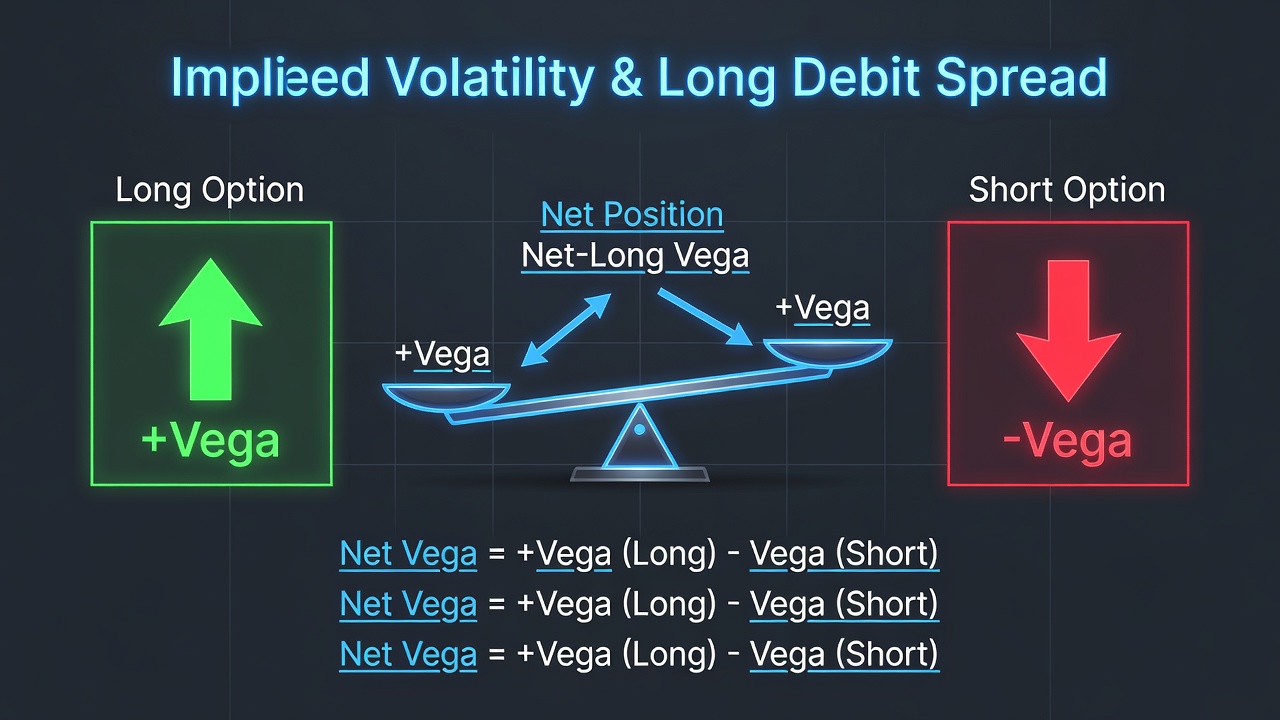
While your net Vega exposure is significantly lower than that of a single long option, it is rarely zero. The long option sits closer to the money and possesses a higher absolute Vega, meaning your position remains net-long volatility.
Understanding Net Vega in Spread Trading
Vega measures how much an option’s price changes for every one-percentage-point shift in implied volatility (IV). In a debit spread, your long option has positive Vega, and your short option has negative Vega.
The difference between these two values is your net Vega. If your net Vega is +0.15, your entire spread will gain $15 in value for every 1% increase in IV, assuming all other pricing variables remain constant.
🎯 Get High-Probability Trade Setups — Free
The Big Dipper Dashboard delivers curated trade ideas straight to your screen every morning. Know what to watch before the opening bell.

How IV Percentile Dictates Your Entry Rules
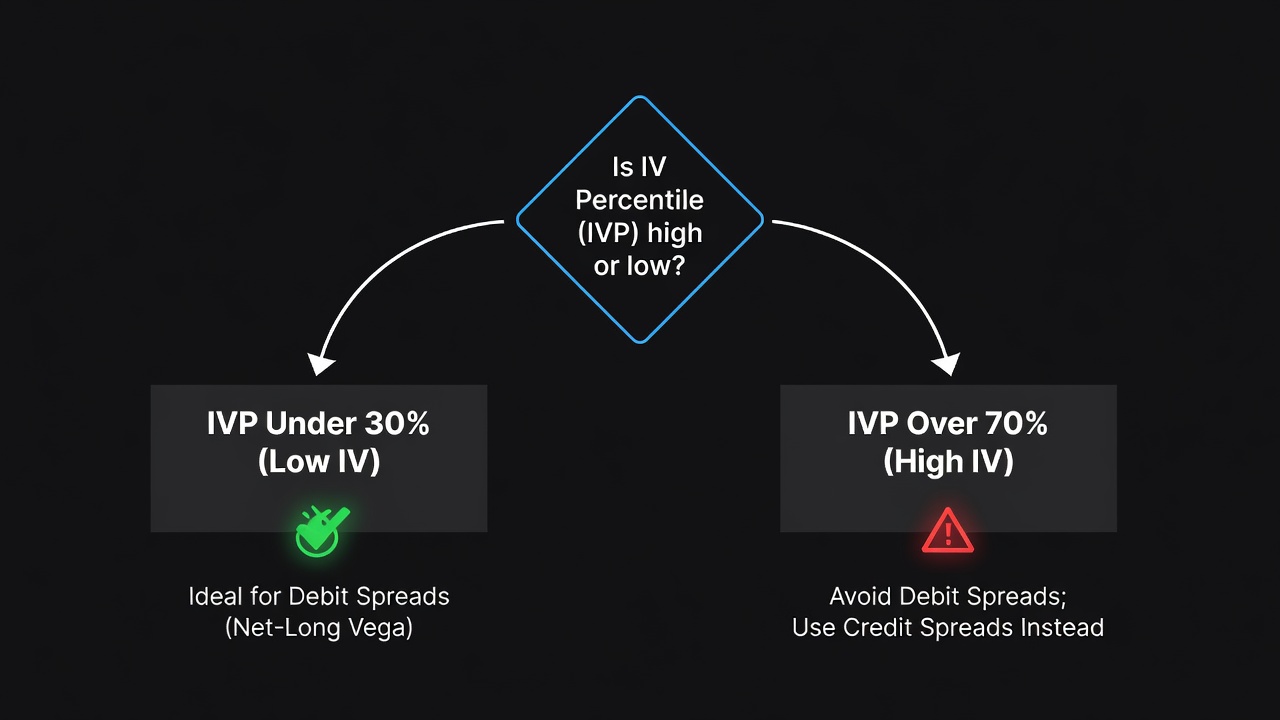
To consistently win with debit spreads, you must evaluate Implied Volatility Percentile (IVP) or Implied Volatility Rank (IVR). These metrics tell you whether the asset’s current volatility is cheap or expensive relative to its historical range.
When IVP is under 30%, options premium is historically cheap. This is the optimal environment to buy debit spreads because any subsequent expansion in volatility will boost the value of your net-long Vega position.
| IV Percentile (IVP) Level | Spread Suitability | Strategic Action Required |
|---|---|---|
| Under 30% (Low IV) | Excellent | Buy debit spreads; cheap premium favors buyers. |
| 30% to 70% (Moderate IV) | Moderate | Target wider strike widths to offset potential IV crush. |
| Over 70% (High IV) | Poor | Avoid buying spreads; pivot to selling credit spreads instead. |
A Real-World Setup: Trading Volatility on SPY
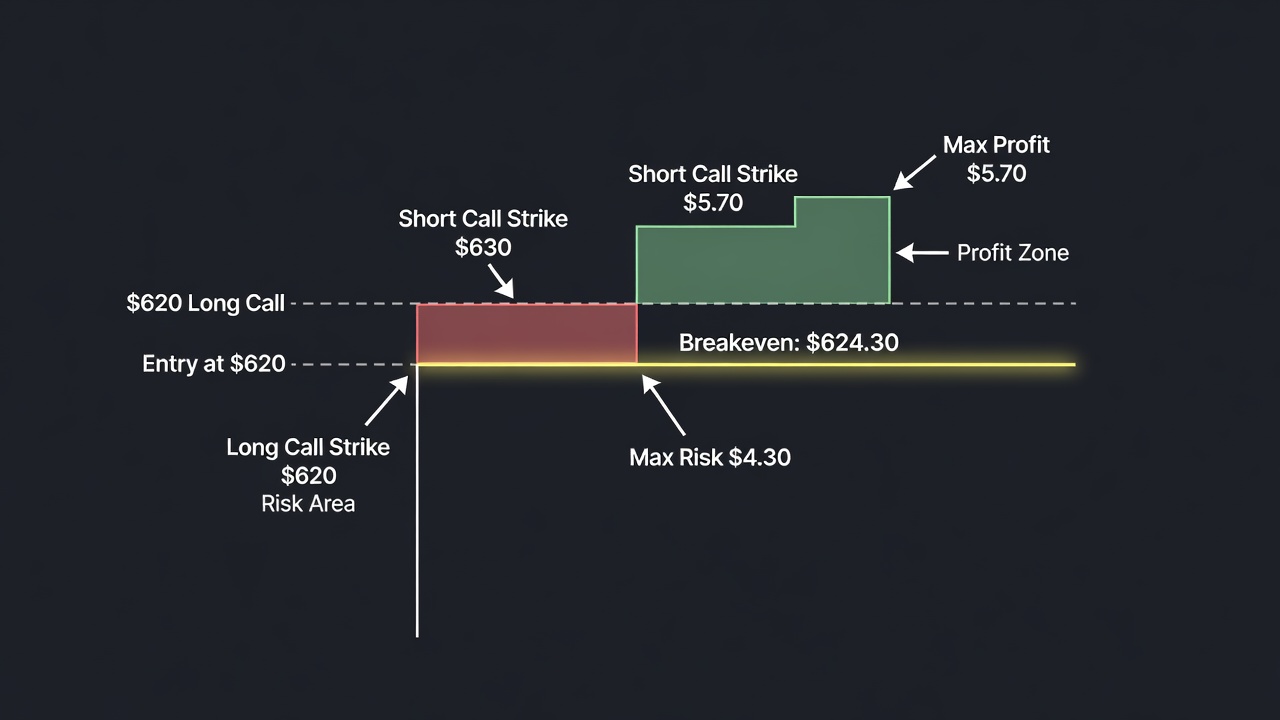
Let us look at a concrete setup using SPY trading at $620, when IV Percentile is exceptionally low at 12%. We construct a bullish call debit spread to capitalize on both an upward move and a anticipated return to average volatility.
You buy the SPY $620 call for $8.40 and sell the SPY $630 call for $4.10. Your net debit is $4.30, your maximum profit is $5.70, and your breakeven point is $624.30.
If SPY moves sideways but market volatility spikes by 5%, your $620 call (Vega +0.32) gains $1.60 in value. Your short $630 call (Vega -0.20) only increases by $1.00, resulting in a net profit of $0.60 solely from the volatility shift.
Common Mistakes to Avoid
Buying debit spreads directly before major earnings announcements is a classic rookie mistake. Even though the spread structure dampens the blow, the post-earnings volatility crush will drag down your net-long Vega position, making it incredibly difficult to profit even if you get the direction right.
Another critical error is ignoring the skew between the strikes you select. If the implied volatility of your short strike is significantly lower than your long strike, you are starting the trade with a structural disadvantage.
Frequently Asked Questions
Does implied volatility crush hurt debit spreads?
Yes, because debit spreads are net-long Vega, a sudden collapse in implied volatility will decrease the overall value of the spread, though the damage is far less than it would be on a single long option.
Should I buy debit spreads in high volatility?
No, you should avoid buying debit spreads when volatility is high because you are paying inflated premiums and exposing your position to volatility contraction.
How does Vega change as expiration approaches?
Vega declines for both options as expiration nears, which reduces your sensitivity to volatility changes and shifts the primary driver of your trade’s value to delta and theta.
Next in our series, we will unpack how time decay acts as both an obstacle and an ally in Part 7: “Time Decay (Theta) in Debit Spreads: Is it Your Friend or Your Foe?”
📈 Want More? Join Our Free Trading Community
- Trading Strategy Guides Telegram — daily strategy tips and market insights
- Find Better Trades Telegram — free trade signals delivered to your phone
- Find Better Trades on YouTube — live trade breakdowns and tutorials