Choosing Strike Prices and Widths for Debit Spreads


📚 The Ultimate Debit Spread Series — Part 5 of 20
- Part 1: What is a Debit Spread? The Ultimate Beginner’s Guide
- Part 2: Call Debit Spreads vs. Put Debit Spreads: Understanding the Core Differences
- Part 3: The Mechanics of a Debit Spread: Max Profit, Max Loss, and Breakeven Explained
- Part 4: Why Trade Debit Spreads Instead of Buying Single Options?
- Part 5: How to Choose the Right Strike Prices and Widths for Your Debit Spreads (you are here)
☑ Key Takeaways
- ITM buy strikes maximize probability of profit, while OTM buy strikes maximize percentage returns.
- Sider spread widths reduce the drag of transaction costs but require more capital and have higher max loss.
- The optimal debit spread setup balances delta, capital allocation, and risk-to-reward ratios.
Most traders choose their debit spread strikes entirely at random. They pick arbitrary numbers because the option premium looks cheap, and then they wonder why their account bleeds cash. Choosing the right strike prices and spread widths is the single most important factor in determining your win rate and long-term profitability.
Welcome to Part 5 of our ultimate debit spread series. Today, we are going to fix your selection process and turn it into a repeatable, mathematical formula.
The Trade-Off: In-the-Money (ITM) vs. Out-of-the-Money (OTM)
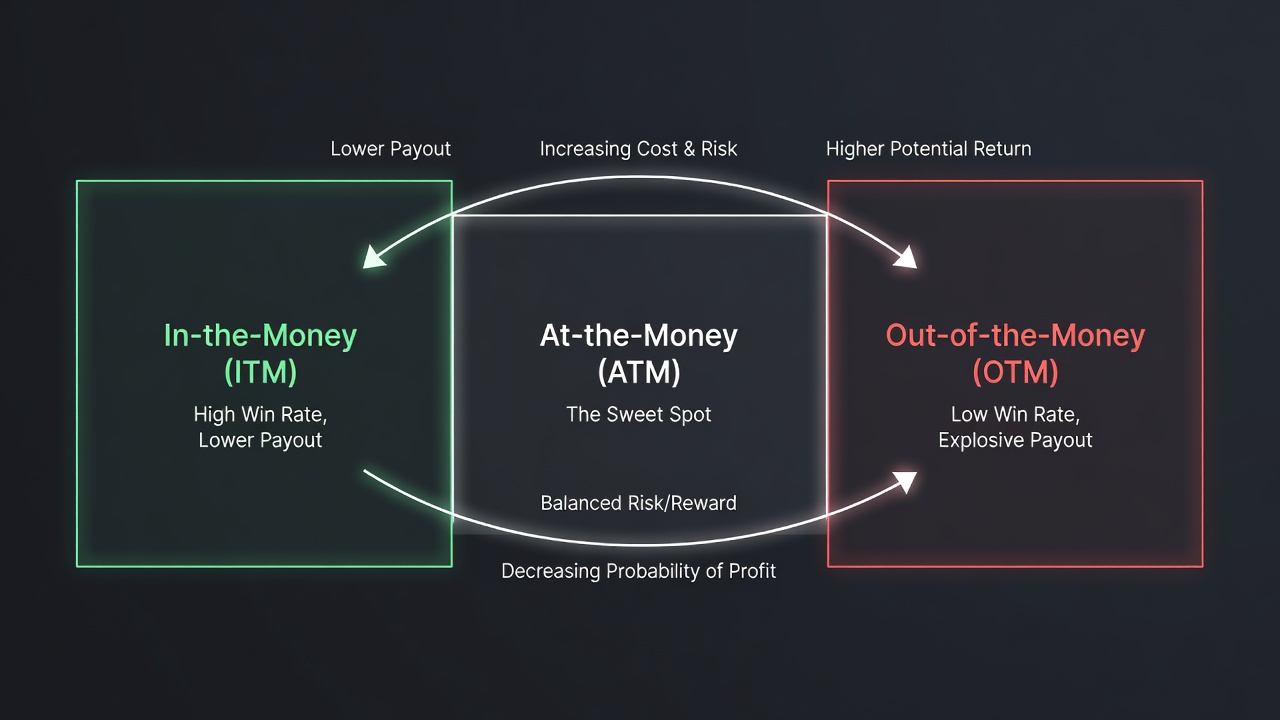
When you build a debit spread, you must decide where to place your long and short strikes relative to the current stock price. This decision directly dictates your probability of winning versus your potential payout.
Choosing an ITM buy option gives you intrinsic value and high delta immediately, meaning the trade starts working in your favor right away. Choosing an OTM buy option is much cheaper, but it requires a larger move in the underlying stock just to reach breakeven.
| Strike Location | Probability of Profit | Max Profit Potential | Cost (Risk) | Required Stock Move |
|---|---|---|---|---|
| In-the-Money (ITM) | High (60%+ ) | Lower | Higher | Can stay flat or move slightly |
| At-the-Money (ATM) | Medium (~50%) | Medium | Medium | Needs moderate direction |
| Out-of-the-Money (OTM) | Low (<40%) | Very High | Very Low | Needs explosive direction |
For most swing traders, the sweet spot is buying an ATM or slightly ITM option, and selling an OTM option. This gives you a balanced coin-flip probability of winning with a reward-to-risk ratio that still makes mathematical sense.
🎯 Get High-Probability Trade Setups — Free
The Big Dipper Dashboard delivers curated trade ideas straight to your screen every morning. Know what to watch before the opening bell.

Determining the Right Spread Width
Spread width is the distance between your long strike and your short strike. It dictates your maximum loss, your maximum profit, and how fast your position will gain value as the stock moves.
Narrow spreads (like $1 or $2 wide) limit your maximum risk to a very small dollar amount, but they limit your upside just as harshly. Wider spreads (like $5, $10, or $20 wide) behave more like naked long options, allowing you to capture larger directional moves without getting capped too early.
As a professional rule of thumb, wider spreads are better for expensive stocks because commissions and bid-ask spreads eat up too much of your edge on narrow spreads. Never trade $1 wide spreads on a stock trading over $300.
A Real-World Setup: Step-by-Step Math
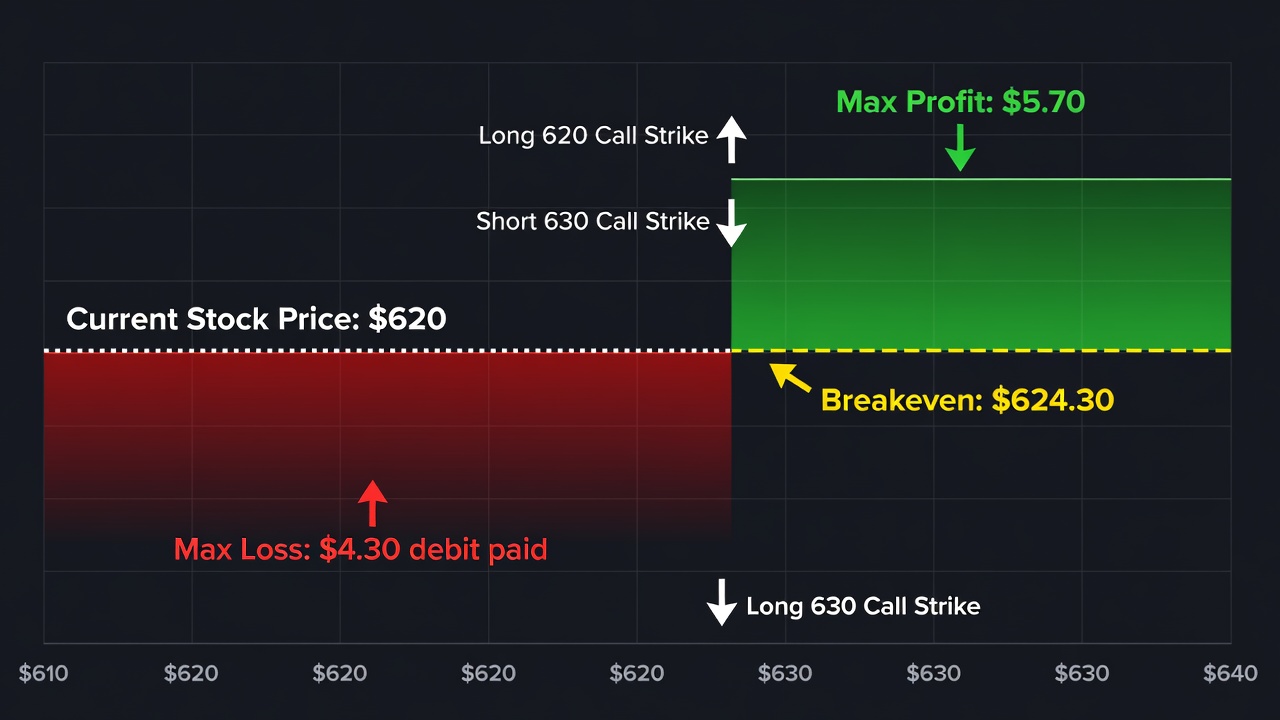
Let’s look at a concrete setup using SPY trading at exactly $620. We will set up a balanced bull call vertical spread, which we covered earlier in the series as a call debit spread.
To execute this trade, we buy the 620 call for $8.40 and sell the 630 call for $4.10. The net debit paid is $4.30 ($8.40 minus $4.10), which is also our maximum possible loss.
Our spread width is $10 ($630 minus $620). To calculate the max profit, we subtract the net debit from the spread width, which gives us $5.70 ($10.00 minus $4.30).
Our breakeven point is the long strike plus the net debit, which is exactly $624.30. If SPY closes anywhere above $630 at expiration, we walk away with the full $5.70 profit, yielding a 132% return on our risked capital.
The Delta-Based Formula for Strike Selection
Stop guessing which strikes to pick. Professional traders use option Delta as a proxy for the probability of an option expiring in-the-money.
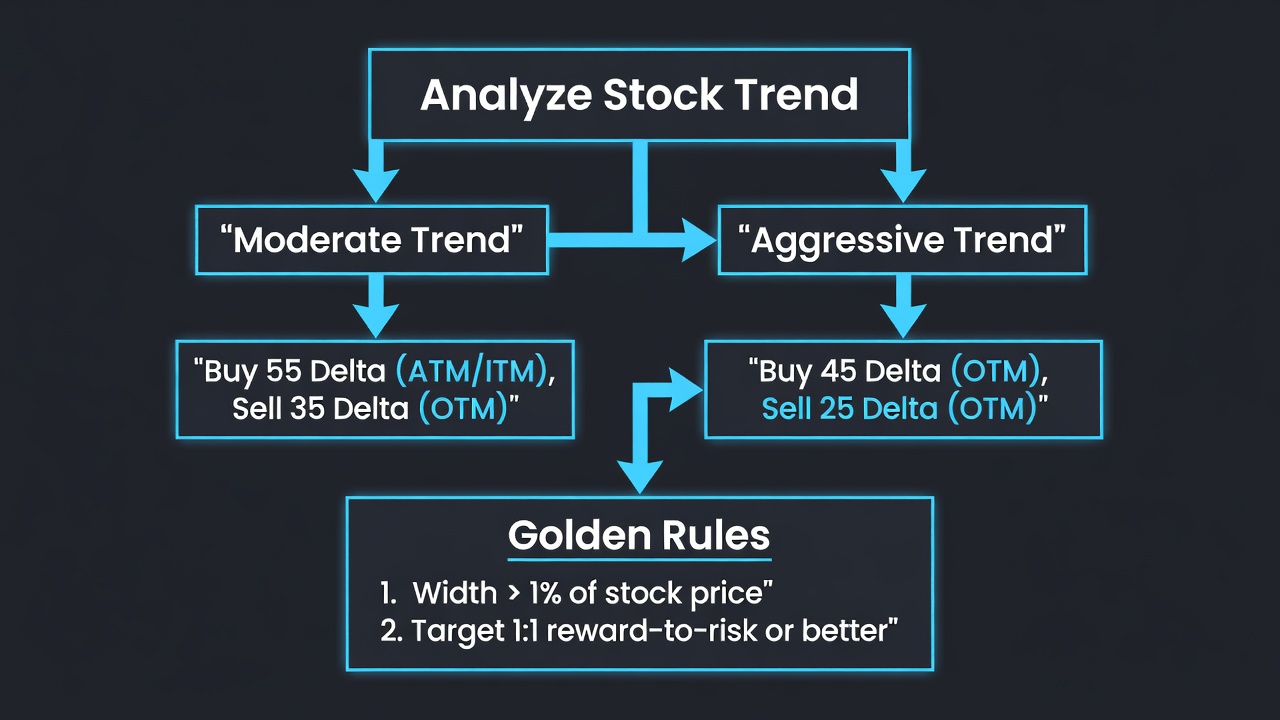
For a reliable, high-probability directional debit spread, buy a strike with a Delta of approximately 50 to 60. This ensures your long option is ATM or slightly ITM and will react quickly to price movements.
Next, sell a strike with a Delta of approximately 30 to 40. This short option provides a significant credit to offset your costs while still leaving plenty of room for the stock to run before hitting your profit cap.
Common Mistakes to Avoid
The most common mistake is buying ultra-cheap, deep OTM spreads. While a $0.10 debit on a $5 wide spread looks like an attractive lottery ticket, the mathematical probability of winning is near zero, and you will slowly bleed your account dry.
Another error is making your spreads too narrow on high-priced stocks. If you trade a $1 wide spread on a $500 stock, the bid-ask spread alone can cost you 20% of your potential profit on entry and exit.
Lastly, do not hold your spreads all the way to expiration hoping for the final few pennies of profit. When a spread achieves 70% to 80% of its maximum value, close it out and lock in your gains rather than risking a late-stage reversal.
Frequently Asked Questions
How wide should my debit spread be?
Your spread width should scale with the underlying stock price; aim for a width of at least 1% to 2% of the stock price to avoid bid-ask drag. For cheaper stocks under $50, $2 to $5 widths work well, while stocks over $300 require $10 to $20 widths.
Is it better to buy ITM or OTM debit spreads?
ITM debit spreads are mathematically superior for consistent income because they have a higher win rate and require less movement from the stock. OTM spreads are highly speculative and should only be used when you anticipate an immediate, explosive directional move.
What delta should I use for debit spreads?
A highly effective standard configuration is to buy a 50 to 60 delta option and sell a 30 to 40 delta option. This strikes the perfect balance between premium discount, high delta exposure, and a reasonable probability of success.
In Part 6 of our series, we will dissect how implied volatility impacts your debit spreads and how to use it to time your entries perfectly.
📈 Want More? Join Our Free Trading Community
- Trading Strategy Guides Telegram — daily strategy tips and market insights
- Find Better Trades Telegram — free trade signals delivered to your phone
- Find Better Trades on YouTube — live trade breakdowns and tutorials