
Why Trade Debit Spreads Instead of Buying Single Options?

📚 The Ultimate Debit Spread Series — Part 4 of 20
- Part 1: What is a Debit Spread? The Ultimate Beginner’s Guide
- Part 2: Call Debit Spreads vs. Put Debit Spreads: Understanding the Core Differences
- Part 3: The Mechanics of a Debit Spread: Max Profit, Max Loss, and Breakeven Explained
- Part 4: Why Trade Debit Spreads Instead of Buying Single Options? (you are here)
⚡ Key Takeaways
- Debit spreads offer a significantly reduced upfront cost and defined maximum risk compared to buying single options.
- The trade-off for reduced cost and risk is a lower maximum profit potential.
- Use debit spreads to express directional conviction with greater capital efficiency and controlled downside.
Many new options traders start by buying single calls or puts, drawn by the allure of uncapped profit. However, this strategy often leads to capital erosion due to high premium costs and the relentless decay of time value. In Part 4 of our “Ultimate Debit Spread Series,” we’re tackling a crucial question: why should you consider trading debit spreads instead of simply buying individual options?
The answer boils down to capital efficiency, risk management, and a more structured approach to directional trading.
Reduced Upfront Cost and Defined Risk
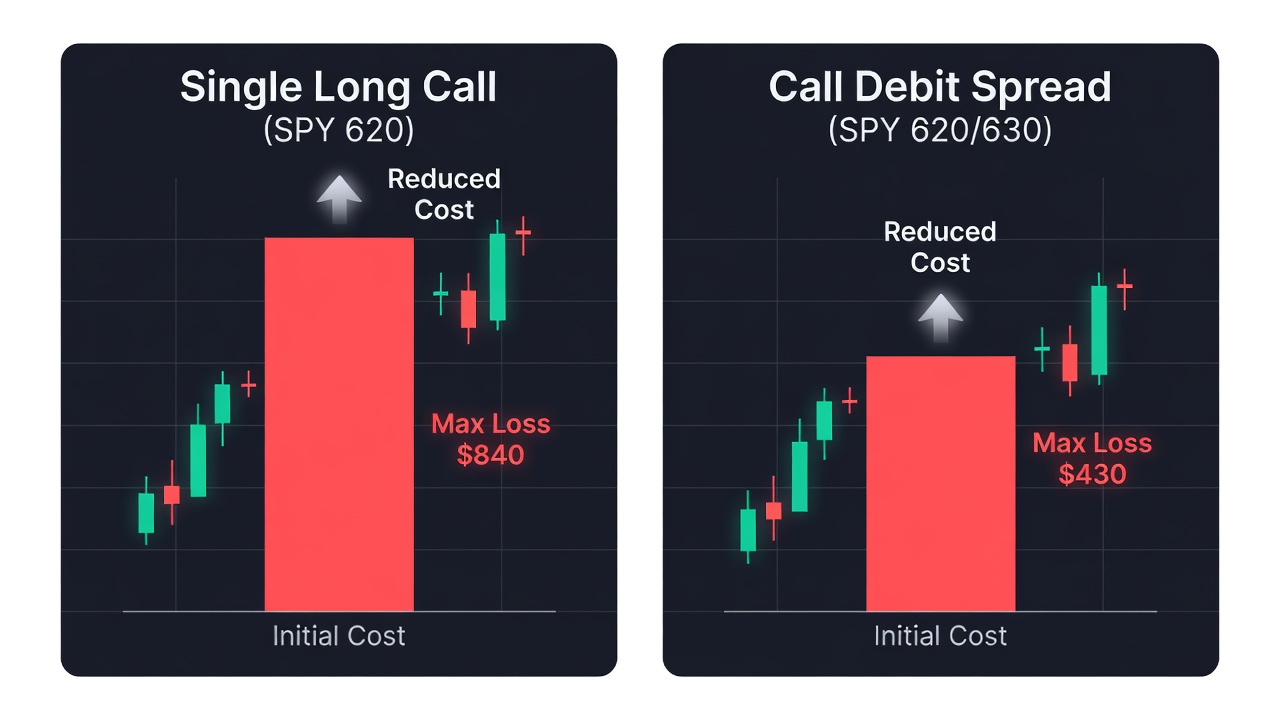
One of the most compelling reasons to favor a debit spread is its lower upfront cost compared to buying a single naked option. When you buy a call or a put, you pay the full premium for that option. With a debit spread, you simultaneously buy an option and sell another option further out-of-the-money (for a call debit spread) or further in-the-money (for a put debit spread).
This sale partially offsets the cost of the option you bought, resulting in a lower net debit. Crucially, this also defines your maximum loss. Your maximum risk is limited to the net debit paid, making capital management far more predictable.
Consider SPY trading at $620. If you expect a move higher, you could buy a single 620 Call expiring in 30 days for $8.40. Your maximum loss is that $840 premium. Alternatively, you could initiate a Call Debit Spread: buy the 620 Call for $8.40 and sell the 630 Call for $4.10. Your net debit is $4.30 ($8.40 – $4.10). Your maximum loss is now $430, less than half the single option cost, for the same directional outlook.
🎯 Get High-Probability Trade Setups — Free
The Big Dipper Dashboard delivers curated trade ideas straight to your screen every morning. Know what to watch before the opening bell.

Enhanced Probability of Profit vs. Single Options
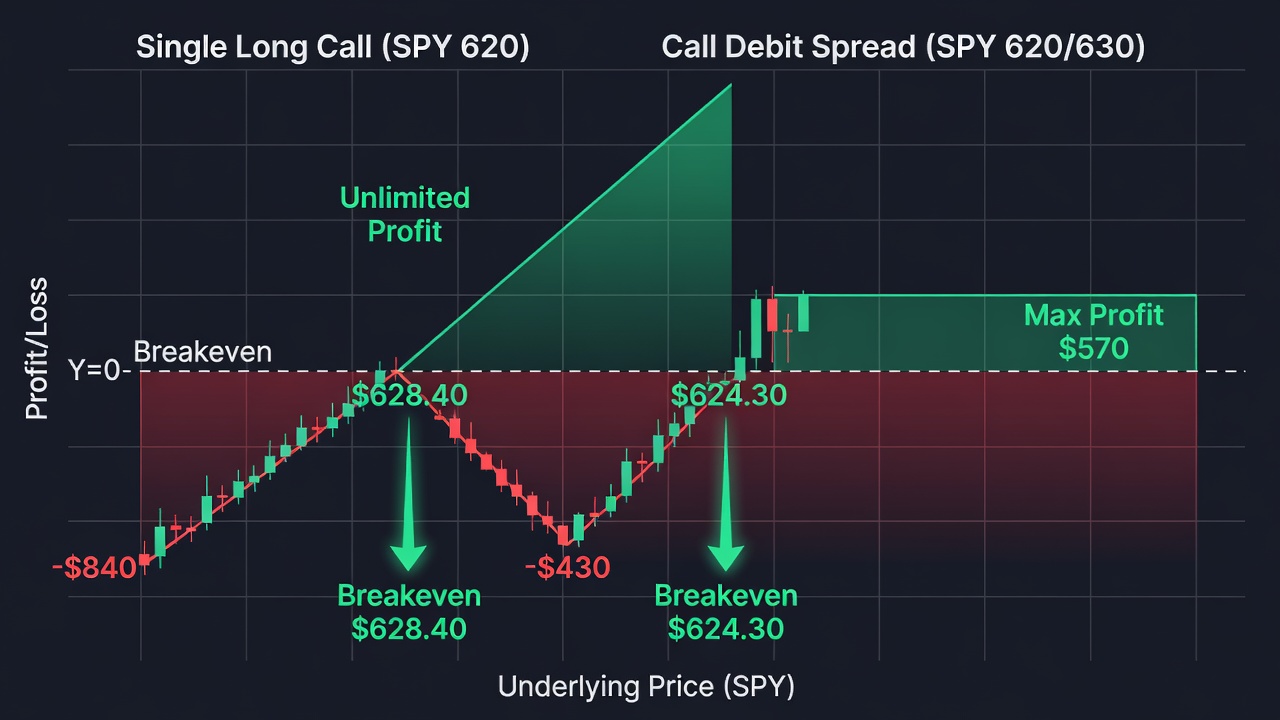
While a single long option offers unlimited profit potential, its probability of profit (POP) at expiration is often lower due to the high hurdle of overcoming premium cost and time decay. A debit spread, by defining its maximum profit, often provides a slightly higher POP in practical trading scenarios, especially for those who are not looking for extreme moves.
The breakeven point for a single long call is the strike price plus the premium paid. For a call debit spread, it’s the strike of the long call plus the net debit. Since the net debit is less than the single call’s premium, the breakeven point is lower for the debit spread. This means the underlying asset needs to move less in your favor for the spread to become profitable.
| Strategy | SPY Long Call (620) | SPY Call Debit Spread (620/630) |
|---|---|---|
| Premium Paid | $8.40 | $4.30 |
| Max Risk | $840 | $430 |
| Breakeven | $620 + $8.40 = $628.40 | $620 + $4.30 = $624.30 |
| Max Profit | Unlimited | $5.70 ($10 spread width – $4.30 debit) |
A lower breakeven point translates directly into a higher theoretical probability of profit, assuming all other factors are equal. This allows you to define your directional view with a better edge.
Mitigating Time Decay (Theta)
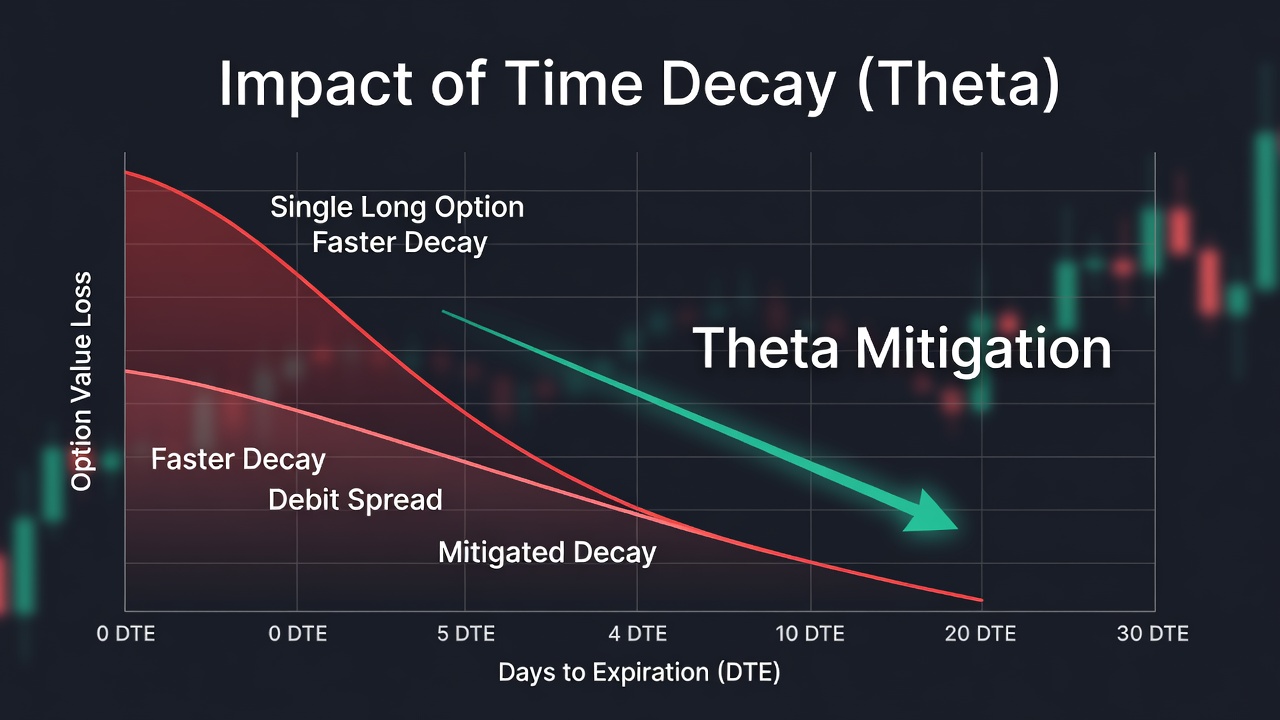
Time decay, or theta, is the enemy of the single long option buyer. Every day that passes, your option loses value, even if the underlying price remains flat. While debit spreads are still net long options and thus susceptible to theta, the impact is mitigated.
This mitigation happens because you are selling an option as part of the spread. The option you sell also experiences time decay, and that decay works in your favor, partially offsetting the decay on the option you bought. The net effect is a slower rate of premium erosion compared to holding a single long option.
This makes debit spreads a more forgiving strategy if the underlying takes a bit longer to make its expected move. You’re not racing against the clock as aggressively as with a naked long option.
Capital Efficiency and Position Sizing
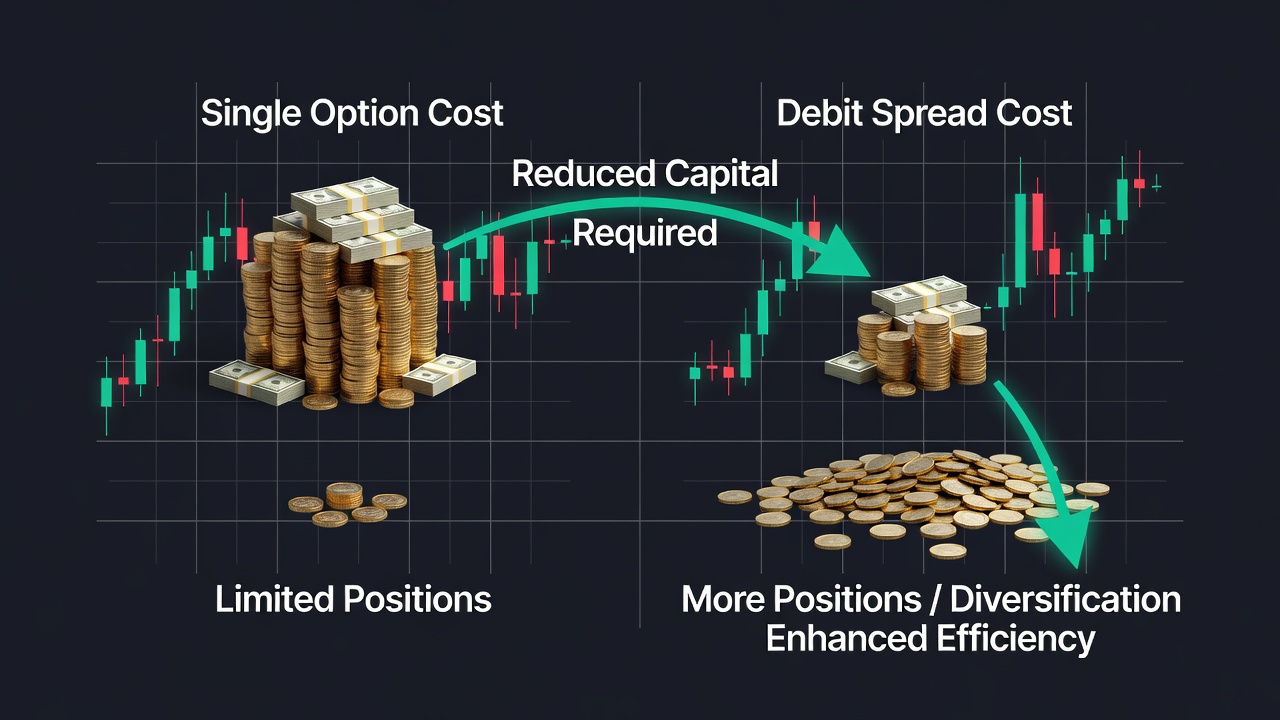
For traders with limited capital, debit spreads offer a significant advantage. The reduced upfront cost allows for more efficient deployment of capital. Instead of allocating a large sum to one single option trade, you can diversify across multiple debit spreads or maintain more cash on hand for other opportunities.
This improved capital efficiency also helps with position sizing. You can achieve similar notional exposure with less capital at risk. For example, if your risk tolerance for a single trade is $500, you could buy one SPY 620 Call and risk $840 (exceeding your tolerance), or you could trade one SPY 620/630 Call Debit Spread, risking $430 (within tolerance). This allows for better adherence to risk management rules and sustainable trading.
Common Mistakes to Avoid
One common mistake is choosing too wide a spread width relative to the premium paid, which can make the trade feel expensive while still limiting upside. A $20 wide spread for a $2 debit might seem appealing for leverage, but the max profit is capped at $18, not unlimited. Another error is over-leveraging by trading too many contracts because the individual debit is low; remember the total maximum loss can still be substantial. Finally, traders often pick strikes that are too far out-of-the-money, making it difficult for the underlying to reach the breakeven point, effectively reducing the probability of profit despite the lower entry cost.
Frequently Asked Questions
What is the main benefit of a debit spread over a single long option? The main benefit is a lower upfront cost and defined maximum risk, making it a more capital-efficient and risk-controlled strategy. Do debit spreads have unlimited profit potential? No, the profit potential of a debit spread is capped at the difference between the strike prices minus the net debit paid. Are debit spreads suitable for beginners? Yes, debit spreads are often recommended for beginners because they cap potential losses, which is crucial for learning options trading without risking excessive capital.
Next, we’ll dive into the critical topic of choosing the right strike prices and widths for your debit spreads to maximize your chances of success.
📈 Want More? Join Our Free Trading Community
- Trading Strategy Guides Telegram — daily strategy tips and market insights
- Find Better Trades Telegram — free trade signals delivered to your phone
- Find Better Trades on YouTube — live trade breakdowns and tutorials