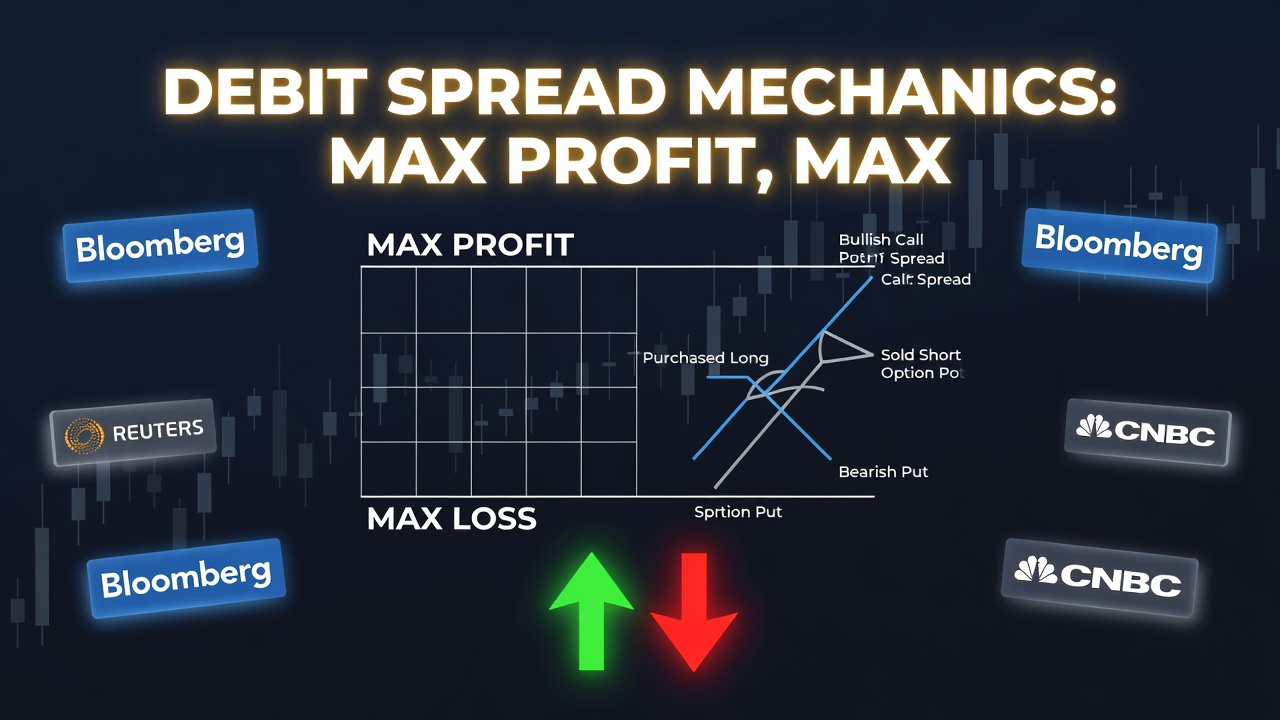
Debit Spread Mechanics: Max Profit, Max Loss, Breakeven

📚 The Ultimate Debit Spread Series — Part 3 of 20
- Part 1: What is a Debit Spread? The Ultimate Beginner’s Guide
- Part 2: Call Debit Spreads vs. Put Debit Spreads: Understanding the Core Differences
- Part 3: The Mechanics of a Debit Spread: Max Profit, Max Loss, and Breakeven Explained (you are here)
⚡ Key Takeaways
- Max profit for a debit spread is capped at the difference between strike prices minus the net debit paid.
- Max loss is always limited to the initial net debit paid to establish the spread.
- The breakeven point is crucial for understanding when your debit spread becomes profitable.
Understanding the maximum profit, maximum loss, and breakeven points for a debit spread is essential before you place a single trade. Without this clarity, you’re trading blind. This guide, Part 3 of our series, cuts through the confusion, equipping you with the precise calculations you need to manage your risk and target your returns.
The Anatomy of Max Profit in a Debit Spread
Maximum profit for a debit spread is always fixed and known at the outset. It occurs when the underlying asset moves favorably past your short option strike at expiration. We covered call and put debit spreads in Part 2; this principle applies to both.
For a call debit spread, max profit is achieved if the stock closes at or above the short call strike at expiration. For a put debit spread, it’s achieved if the stock closes at or below the short put strike.
The formula is simple: (Difference between Strike Prices) – (Net Debit Paid).
Let’s use an example with a call debit spread. Suppose SPY is trading at $620. You buy the 620 call for $8.40 and sell the 630 call for $4.10. Your net debit is $8.40 – $4.10 = $4.30.
The difference between the strike prices is $630 – $620 = $10.00. Your maximum profit is $10.00 – $4.30 = $5.70. This means for every share represented by the options (100 shares), your maximum profit is $570.
So what do you do with this? Knowing your max profit helps you assess the reward relative to the risk. Is $5.70 per share worth the $4.30 per share debit? It’s a key part of your trade thesis.
Defining Max Loss for a Debit Spread
The beauty of a debit spread, which we touched on in Part 1, is its defined risk. Your maximum loss is limited to the net debit you pay when entering the trade. This is a significant advantage over buying a naked option, where the full premium paid is at risk.
For a call debit spread, maximum loss occurs if the stock closes at or below your long call strike at expiration. For a put debit spread, maximum loss occurs if the stock closes at or above your long put strike.
The formula is straightforward: Max Loss = Net Debit Paid.
Revisiting our SPY example: you paid a net debit of $4.30 for the spread. This means your absolute maximum loss on this trade is $4.30 per share, or $430 for a standard contract. This loss occurs if SPY finishes at or below $620 at expiration.
So what do you do with this? This fixed maximum loss is your risk capital at stake. It allows you to size your positions appropriately and never face unexpected downside. If $430 is too much for your account, you shouldn’t place this trade.
🎯 Get High-Probability Trade Setups — Free
The Big Dipper Dashboard delivers curated trade ideas straight to your screen every morning. Know what to watch before the opening bell.

Calculating the Breakeven Point
The breakeven point is where your debit spread begins to become profitable. It’s the price at which the underlying asset needs to be at expiration for you to neither make nor lose money.
The calculation differs slightly for call and put debit spreads:
- Call Debit Spread Breakeven: Long Call Strike + Net Debit Paid
- Put Debit Spread Breakeven: Long Put Strike – Net Debit Paid
Using our SPY call debit spread example: Long Call Strike = $620. Net Debit Paid = $4.30.
Breakeven = $620 + $4.30 = $624.30. This means SPY needs to be above $624.30 at expiration for this trade to be profitable. If SPY is exactly $624.30, you break even. If it’s above, you profit.
Consider a put debit spread example. Let’s say you buy the 400 put for $5.00 and sell the 390 put for $2.00, paying a net debit of $3.00. Your long put strike is $400. Breakeven = $400 – $3.00 = $397.00. The stock needs to be below $397.00 at expiration for you to profit.
So what do you do with this? The breakeven point is your target. It’s the hurdle the market needs to clear for your trade to succeed. Compare it to the current price and your forecast. Is it a realistic target?
Putting It All Together: A Worked Example
Let’s consolidate the mechanics with a full example for a different underlying, XYZ, currently trading at $105.
You decide to place a call debit spread:
- Buy 1 XYZ 100-strike call @ $7.00
- Sell 1 XYZ 110-strike call @ $2.50
First, calculate the Net Debit Paid:
- $7.00 (premium paid) – $2.50 (premium received) = $4.50 (Net Debit)
Next, determine Max Loss:
- Max Loss = Net Debit Paid = $4.50 per share (or $450 per contract).
Then, calculate Max Profit:
- Difference between strikes = $110 – $100 = $10.00
- Max Profit = $10.00 – $4.50 = $5.50 per share (or $550 per contract).
Finally, find the Breakeven Point:
- Breakeven = Long Call Strike + Net Debit Paid = $100 + $4.50 = $104.50.
| Metric | Calculation | Result (per share) |
|---|---|---|
| Net Debit Paid | $7.00 – $2.50 | $4.50 |
| Max Loss | Net Debit Paid | $4.50 |
| Max Profit | ($110 – $100) – $4.50 | $5.50 |
| Breakeven | $100 + $4.50 | $104.50 |
So what do you do with this? This comprehensive view allows you to see the entire risk/reward profile of the trade before entry. XYZ needs to be above $104.50 at expiration for profit, with a maximum profit of $5.50 if it’s at or above $110, and a maximum loss of $4.50 if it’s at or below $100.
Common Mistakes to Avoid
Traders frequently make critical errors when calculating or interpreting these debit spread mechanics.
One common mistake is confusing the long strike with the short strike for breakeven calculations, especially with puts. Always remember the direction of the underlying you are betting on. For calls, it’s long strike plus debit; for puts, it’s long strike minus debit.
Another pitfall is ignoring the impact of time decay (theta) on your breakeven. While the mathematical breakeven is fixed, the actual stock price required for you to exit profitably before expiration can be higher than calculated. Don’t assume the market will just hit your breakeven. Always consider how much time is left and your probability of success.
Finally, some traders overlook commission costs when calculating net debit. While small, they eat into your maximum profit and push your breakeven point slightly further. Factor all trading costs into your initial debit to get a truly accurate picture of your max loss and profit.
Frequently Asked Questions
What happens if the stock price is exactly at the breakeven point at expiration? You neither make nor lose money on the options, as the value of the spread will exactly equal your initial debit paid.
Can I close a debit spread for a profit before expiration? Yes, if the underlying moves favorably and the spread’s value increases beyond your initial debit, you can close it for a profit before expiration.
Is the maximum profit truly unlimited if the stock skyrockets past the short strike? No, your profit is capped at the difference between the strikes minus your net debit, regardless of how high the stock goes beyond your short strike.
Next, we’ll explore why trading debit spreads often makes more sense than simply buying single options outright.
📈 Want More? Join Our Free Trading Community
- Trading Strategy Guides Telegram — daily strategy tips and market insights
- Find Better Trades Telegram — free trade signals delivered to your phone
- Find Better Trades on YouTube — live trade breakdowns and tutorials