SMC Inducement and FVG Strategy: Trading Western Digital Post-Earnings

When institutional catalysts trigger massive, high-volume sell-offs in major semiconductor stocks like Western Digital (WDC), retail traders panic while market makers engineer liquidity. The SMC Inducement and FVG Strategy is designed to exploit this institutional behavior. By identifying exactly where retail stop-losses are clustered (the inducement) and where price imbalances remain unfilled (the Fair Value Gap), this strategy allows you to enter high-probability short setups with tight risk and explosive reward ratios. It is built specifically for active day and swing traders who want to stop being the liquidity and start trading alongside the institutions that move the market.
What Is SMC Inducement and Fair Value Gaps?
The SMC Inducement and FVG Strategy is a trading methodology derived from Smart Money Concepts that focuses on tracking institutional order flow. Inducement is a specific market structure element where the market maker deliberately engineers a minor swing high or low to lure retail traders into early positions, creating a pool of stop-losses. A Fair Value Gap (FVG) is a three-candle price imbalance that occurs when aggressive buying or selling leaves a gap in price delivery, which acts as a magnet for future price action. While popularized by modern SMC and ICT educators, these concepts are rooted in classic Wyckoffian principles of accumulation, distribution, and spring setups.
Why This Edge Works
Markets do not move randomly; they move from one pool of liquidity to another to match buy and sell orders. When a stock like Western Digital experiences an earnings-driven plunge, a massive imbalance is created. Retail traders view the initial bounce as a trend reversal and place their stop-losses just below the minor pullback lows, or they chase the breakout of minor swing highs, placing stop-losses just above them. Smart money algorithms target these highly concentrated retail stop-loss clusters (inducement) to fuel their own large positions. By waiting for the market to sweep this engineered inducement directly into an unmitigated Fair Value Gap, you align your entry with institutional repricing, ensuring high win rates and asymmetrical risk-to-reward profiles.
The Setup Rules
To identify a high-probability short setup in Western Digital or any highly liquid stock post-earnings, you must strictly follow these structural rules:
- Determine the HTF Trend: Identify a clear bearish displacement on the 1-hour or 4-hour High Timeframe (HTF), characterized by aggressive selling and a clear Break of Structure (BOS) to the downside.
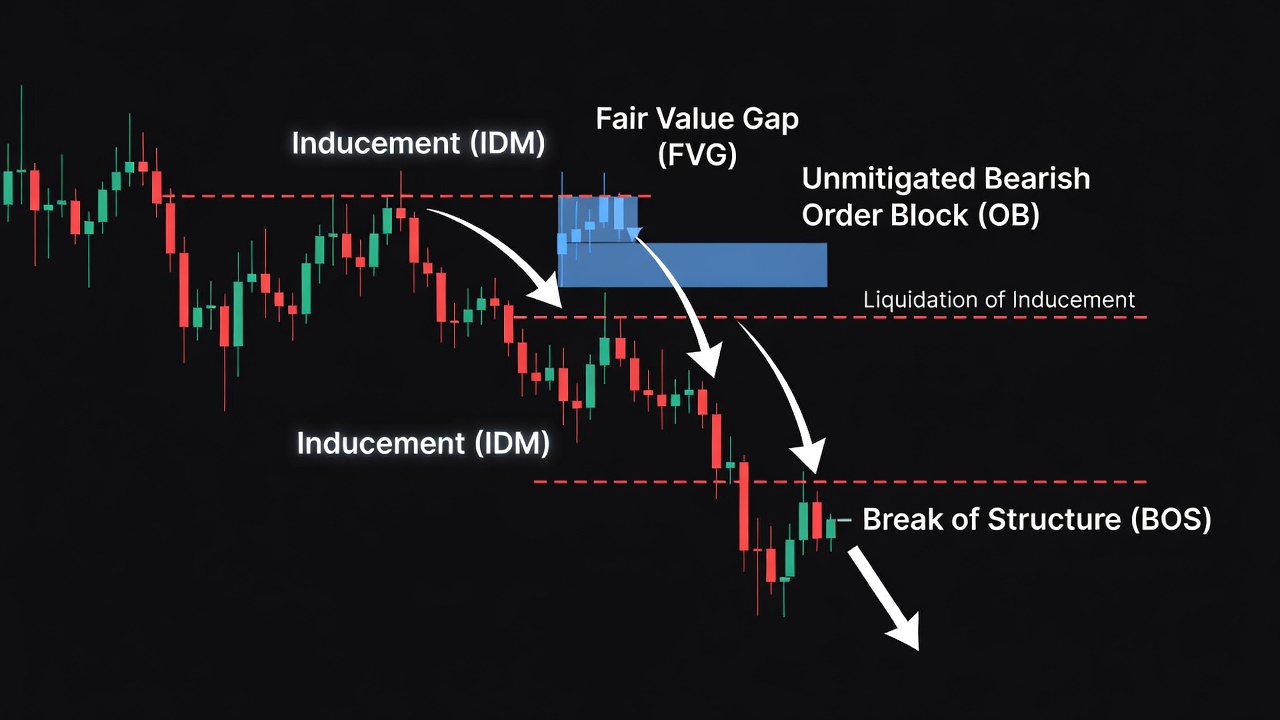
- Locate the Inducement (IDM): On the 15-minute execution timeframe, locate the first minor swing high that was formed after the bearish displacement. This minor high represents the retail inducement level.
- Identify the Unmitigated FVG: Locate a 3-candle Fair Value Gap residing directly above or resting adjacent to the inducement level. The FVG must not have been touched or ‘mitigated’ by subsequent price action.
- Confirm the Premium Array: Ensure the FVG and Inducement reside in the ‘Premium’ zone of the current trading range. Draw a Fibonacci retracement from the swing high to the swing low of the bearish leg; the setup must be above the 50% equilibrium level.
Entry Trigger
Your entry is triggered when price surges upward to sweep the liquidity resting above the identified Inducement level and taps into the open 15-minute Fair Value Gap. For aggressive entries, place a limit order at the open boundary of the FVG once the inducement high is breached. For conservative entries, wait for a lower-timeframe (1-minute or 3-minute) Change of Character (CHOCH) to the downside immediately after the 15-minute FVG tap, entering on the subsequent retracement.
Stop Loss & Profit Target
The stop loss must be placed precisely 2-5 cents above the invalidation level, which is the swing high of the bearish Order Block that formed the original displacement leg. This ensures that if the bearish structure is completely invalidated, you exit with a minimal, controlled loss. The primary profit target is set just above the major sell-side liquidity pool, which is the swing low of the entire bearish run. This structural placement typically yields a risk-to-reward ratio of at least 3:1 or 4:1, allowing you to remain highly profitable even with a moderate win rate.
Trade Walkthrough: What It Looks Like on a Chart
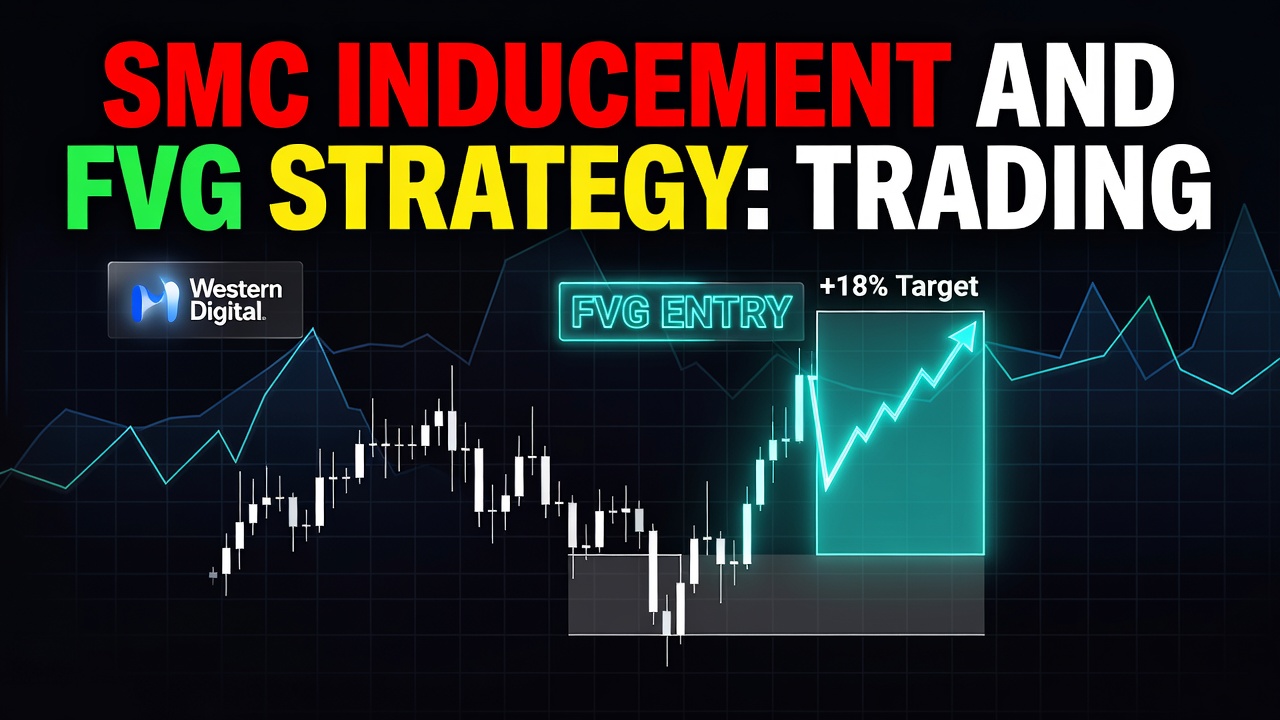
Let’s walk through a real-world trading scenario on Western Digital (WDC) on the 15-minute chart following an earnings-driven sector plunge. As you can see in the chart above, WDC aggressively broke structure to the downside, dropping from $68.00 down to $61.00, leaving a massive volume footprint. This rapid descent created a clear daily and 4-hour bearish bias. Following the initial sell-off, price began to corrective-rally back upward, forming a minor swing high at $64.50. This minor swing high is our identified Inducement (IDM), where early retail shorts placed their stops, and breakout buyers set pending buy stop orders.
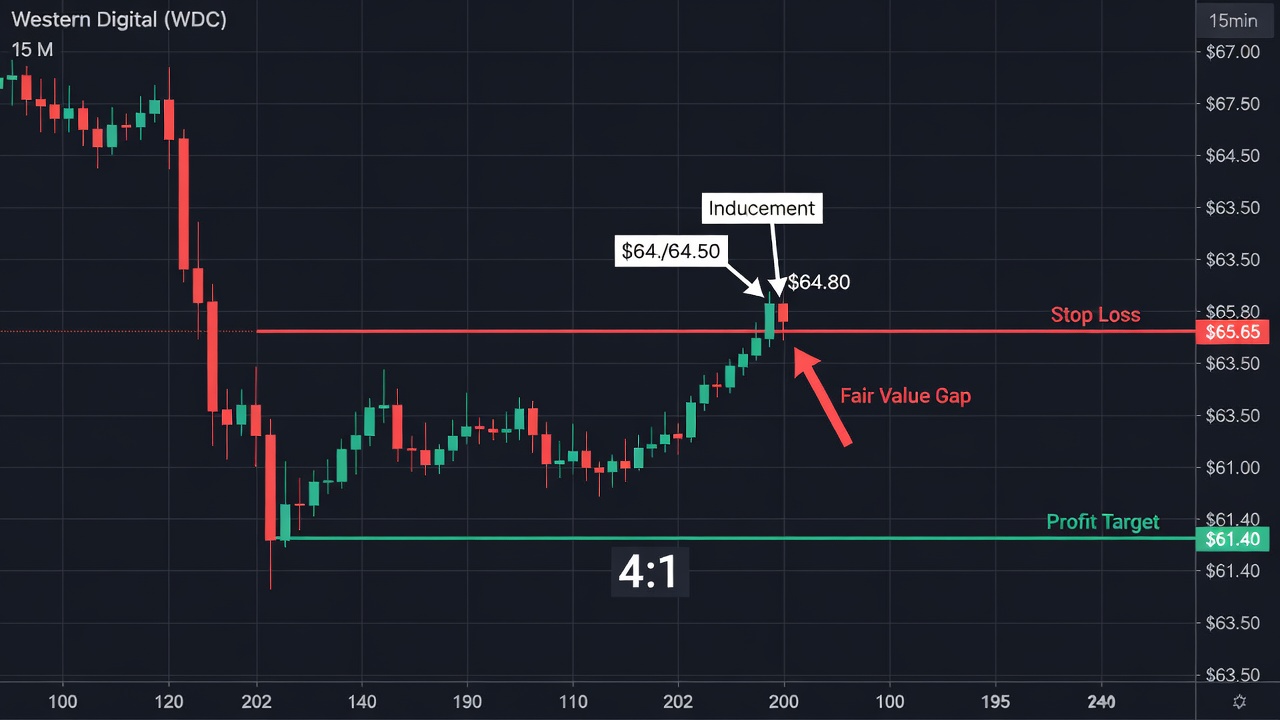
Directly above this inducement, between $64.70 and $65.20, lay an unmitigated 15-minute Fair Value Gap, capped by a bearish Order Block at $65.60. On the execution day, price rallied sharply, sweeping through the $64.50 inducement high. This move engineered buy-side liquidity by triggering retail stop-losses and trapping breakout traders. The moment price swept the inducement, it tapped directly into our FVG at $64.80. We triggered a short entry at $64.80. The stop loss was positioned at $65.65, just above the bearish Order Block. WDC immediately rejected the FVG and reversed violently downward, targeting the sell-side liquidity at the previous swing low of $61.40. The trade reached its profit target swiftly, securing a clean 4:1 risk-to-reward ratio.
Common Mistakes to Avoid
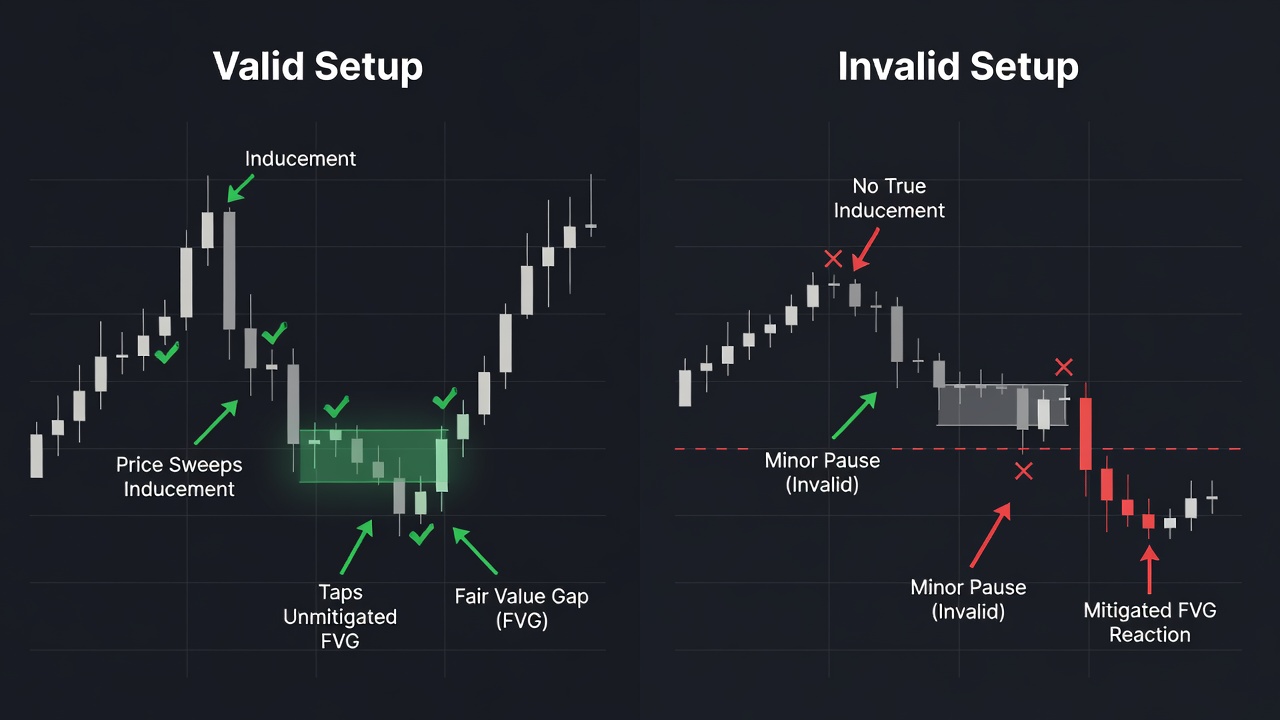
- Trading Mid-Range Imbalances: Entering trades inside FVGs that do not have a clear inducement high swept right before them; these gaps are often run through by market makers seeking deeper liquidity.
- Ignoring Premium vs. Discount: Taking short setups that form below the 50% equilibrium level of the trading range, where sellers are already exhausted.
- Force-Fitting Setups on Low Volume: Attempting to trade this strategy during low-volume lunchtime hours or market doldrums when institutions are not actively moving price.
- Placing Tight Stops inside the FVG: Placing the stop loss in the middle of the FVG rather than above the structural swing high, leading to premature stop-outs during normal volatility wick-outs.
Quick Reference Checklist
- Is the overall high-timeframe trend (1H or 4H) clearly aligned with your trade direction? (Yes/No)
- Has a clear Break of Structure (BOS) occurred on the 15-minute execution timeframe? (Yes/No)
- Is there a distinct swing high/low acting as an engineered Inducement (IDM)? (Yes/No)
- Is there an unmitigated Fair Value Gap (FVG) positioned directly behind the Inducement? (Yes/No)
- Does the FVG rest within the Premium zone (above 50% Fib) for shorts, or Discount zone (below 50% Fib) for longs? (Yes/No)
- Has the Inducement level been swept before price tapped into the FVG? (Yes/No)
- Is your stop loss positioned safely behind the structural invalidation level/Order Block? (Yes/No)
🎯 Get High-Probability Trade Setups — Free
The Big Dipper Dashboard delivers curated trade ideas straight to your screen every morning. Know what to watch before the opening bell.

📈 Want More? Join Our Free Trading Community
- Trading Strategy Guides Telegram — daily strategy tips and market insights
- Find Better Trades Telegram — free trade signals delivered to your phone
- Find Better Trades on YouTube — live trade breakdowns and tutorials