The Phantom Anchor: Capture High-Probability Reversals Off VWAP

Most intraday traders get trapped buying tops or shorting bottoms because they chase breakouts after momentum is already exhausted. The Phantom Anchor fixes this exact flaw by combining institutional value anchoring with precision liquidity sweep triggers. Built specifically for active day traders and scalpers operating on 3-minute to 15-minute timeframes, this strategy systematically catches high-probability trend retests right as weak hands get flushed out. By anchoring your directional bias to the 50 EMA and timing your entries off VWAP sweeps confirmed by Stochastic RSI momentum, you stop guessing intraday turning points and start trading alongside institutional order flow.
What Is The Phantom Anchor?
The Phantom Anchor is a hybrid trend-continuation and mean-reversion strategy designed to exploit retail stop-hunting around dynamic institutional fair value levels. It operates on the core principle that institutional algorithms routinely push price slightly through VWAP to pick up liquidity before pushing the market back in the prevailing direction of the higher trend. This system is tailor-made for day traders on FX majors, index futures, and high-volume equities who want strict rules with zero guesswork.
Indicators You Need
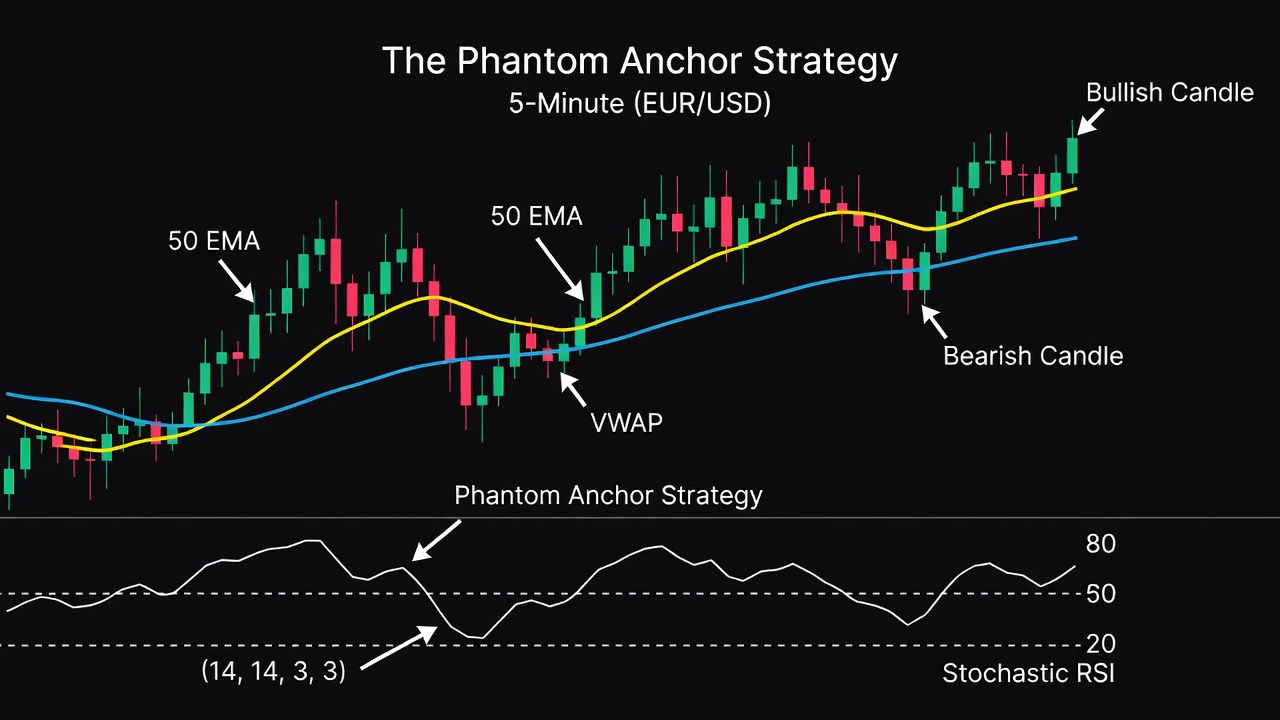
- 50-Period Exponential Moving Average (EMA): Serves as your primary trend filter; price must be cleanly positioned on the correct side with a clear slope to establish directional permission.
- Volume-Weighted Average Price (VWAP): Acts as the phantom anchor point where institutional liquidity sits; you only look for setups when price tests or wicks through this line.
- Stochastic RSI (Settings: 14, 14, 3, 3): Provides the exact momentum cross trigger; filters out early entries by requiring an extreme overbought or oversold reading before crossing.
Recommended Timeframes: 3-minute, 5-minute, and 15-minute intraday charts.
The Phantom Anchor Rules — Step by Step
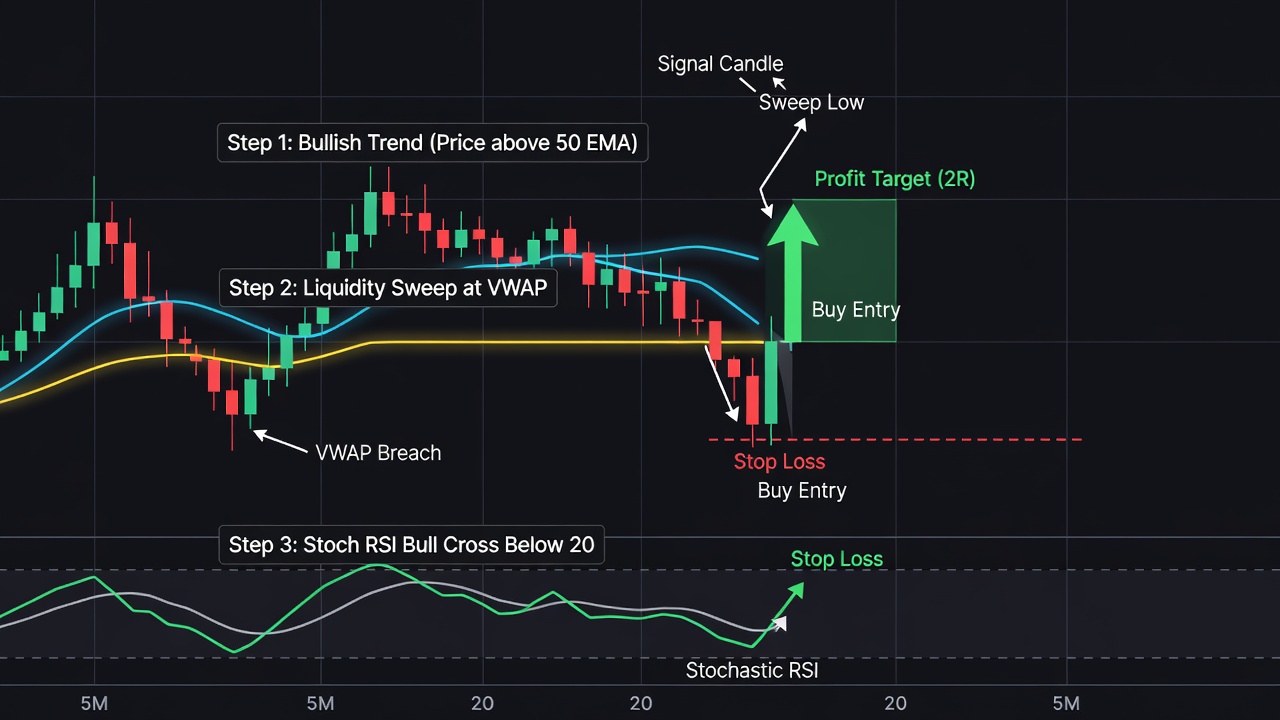
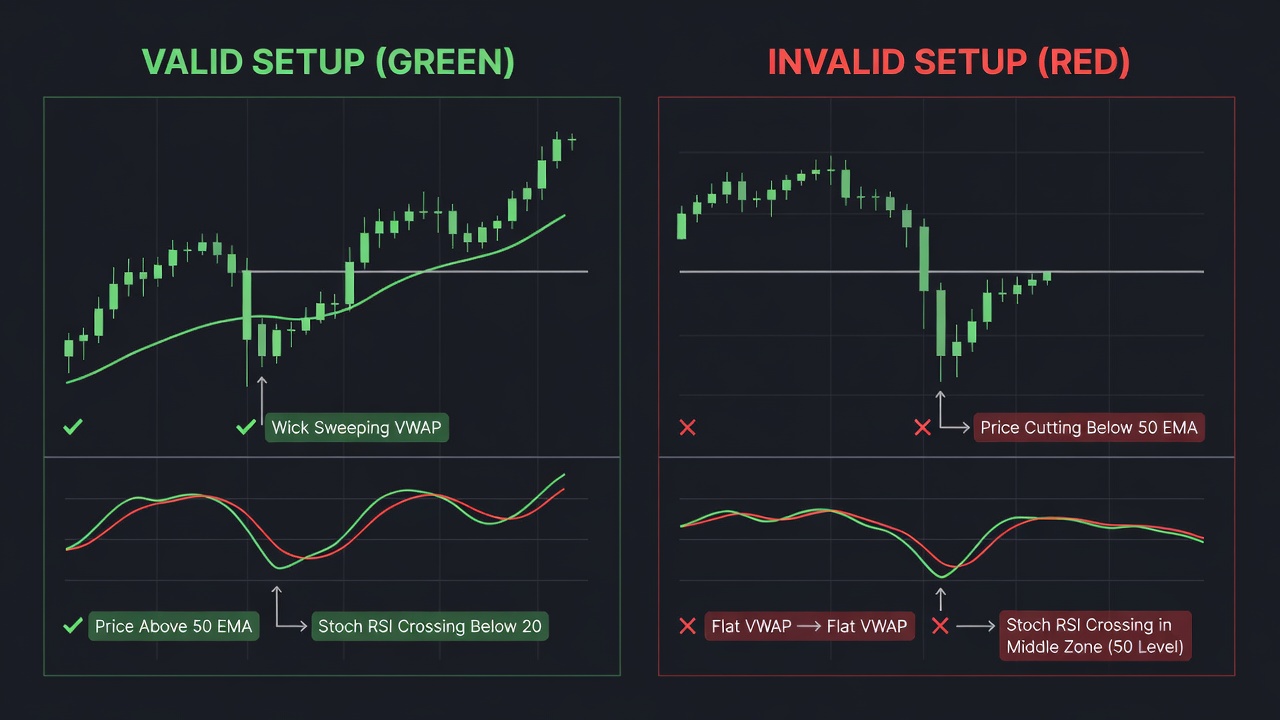
- Chart Setup & Trend Permission: Load the 50 EMA, session VWAP, and Stochastic RSI (14,14,3,3) on your chart. For a buy setup, the 50 EMA must be sloping upward and price must be trading above the 50 EMA. For a sell setup, the 50 EMA must be sloping downward and price must be trading below the 50 EMA. If price is chopping back and forth through the 50 EMA, walk away.
- The VWAP Liquidity Sweep Signal: Wait for price to pull back toward the VWAP line. For a buy trade, price must print a candle whose lower wick pierces or sweeps directly into/below the VWAP line, but the candle body must close above or directly on VWAP. This confirms institutional buyers defended the anchor level and absorbed retail sell stops.
- The Stochastic RSI Execution Trigger: Look down at the Stochastic RSI window on the exact same candle or the immediate subsequent candle. For a buy setup, the %K line must cross above the %D line while inside or exiting the oversold zone (below 20). When both the candle close and the indicator cross align on the same candle, trigger your market entry immediately on the close.
Entry, Stop Loss & Profit Target
Precision execution requires fixed risk parameters established prior to entering the market.
- Entry Price: Enter market order immediately at the close of the trigger candle that fulfills the VWAP sweep and Stochastic RSI cross simultaneously.
- Stop Loss Placement: Place your stop loss 2 to 3 pips (or ticks) beyond the extreme wick low of the liquidity sweep candle. This ensures you are invalidated only if the institutional defense fails completely.
- Profit Target: Set a fixed profit target at a minimum 2:1 Reward-to-Risk ratio (2R), or target the recent swing high/low structure prior to the pullback.
- Risk/Reward Profile: Expect an average risk-to-reward profile of 1:2 to 1:3 per trade, with an aggressive win rate when traded during high-volume sessions (London/New York open).
Common Mistakes to Avoid
- Entering when the 50 EMA is flat: Trading VWAP bounces in a sideways market leads to constant whipsaws because there is no dominant institutional trend backing the move.
- Accepting candle bodies below VWAP: If a candle closes distinctly below VWAP during a buy setup, the level is broken, not swept. Do not take the trade.
- Taking late Stochastic RSI crosses: If the Stochastic RSI crosses above 50 by the time you notice it, the entry edge is gone. Take entries only when the cross happens in extreme territory (below 20 for longs, above 80 for shorts).
- Ignoring economic news releases: High-impact red folder news events destroy technical anchor levels. Never hold active Phantom Anchor orders through Tier-1 data releases like NFP or CPI.
Quick Reference Checklist
- Is the 50 EMA clearly sloping in the direction of your intended trade? (Yes/No)
- Is current price positioned on the correct side of the 50 EMA? (Yes/No)
- Has price pulled back and swept the VWAP line with a clear candle wick? (Yes/No)
- Did the sweep candle body close on the favorable side of VWAP? (Yes/No)
- Is the Stochastic RSI currently crossing out of extreme territory (<20 for longs, >80 for shorts)? (Yes/No)
- Is your stop loss safely placed beyond the extreme wick of the sweep candle? (Yes/No)
- Does your take profit level offer at least 2R before hitting major structural hurdles? (Yes/No)
Frequently Asked Questions
Q: What asset classes work best with The Phantom Anchor?
A: High-liquidity instruments with true volume data perform best. Index futures (NQ, ES), Forex majors (EUR/USD, GBP/USD), and high-volume mega-cap stocks yield the cleanest VWAP sweeps.
Q: Can I trade this strategy on the 1-hour or daily chart?
A: No. VWAP is an intraday calculation that resets every session. For higher timeframes, substitute VWAP with a 20-period Hull Moving Average or Anchored VWAP from key structural swing points.
Q: What if the Stochastic RSI crosses one candle after the VWAP sweep?
A: A one-candle delay is acceptable as long as price remains consolidating near VWAP without breaching your stop level. If the cross takes 3 or more candles, discard the setup.
Free For Traders
Know The EXACT Moment A Stock Hits Support Or Resistance
Real-time alerts fire the instant a stock approaches a critical level. Completely free.

From Find Better Trades
Catch The Reversal Before It Wrecks Your Gains
Pattern-recognition scanner that spots bearish reversals early — protect your profits or time short entries with confidence.

📈 Want More? Join Our Free Trading Community
- Trading Strategy Guides Telegram — daily strategy tips and market insights
- Find Better Trades Telegram — free trade signals delivered to your phone
- Find Better Trades on YouTube — live trade breakdowns and tutorials