

The Volt Siphon: Capture Explosive Momentum Shifts


When markets shift from quiet consolidation to explosive expansion, most retail traders get caught on the wrong side of the move. The Volt Siphon is a high-velocity momentum trading strategy designed to exploit institutional volume surges at the precise moment a new trend ignites. By combining structural price breaks with a hyper-responsive trend filter and institutional order flow confirmation, this system gives day traders and aggressive swing traders an edge that eliminates analysis paralysis and gets them into the trend before the rest of the herd reacts.
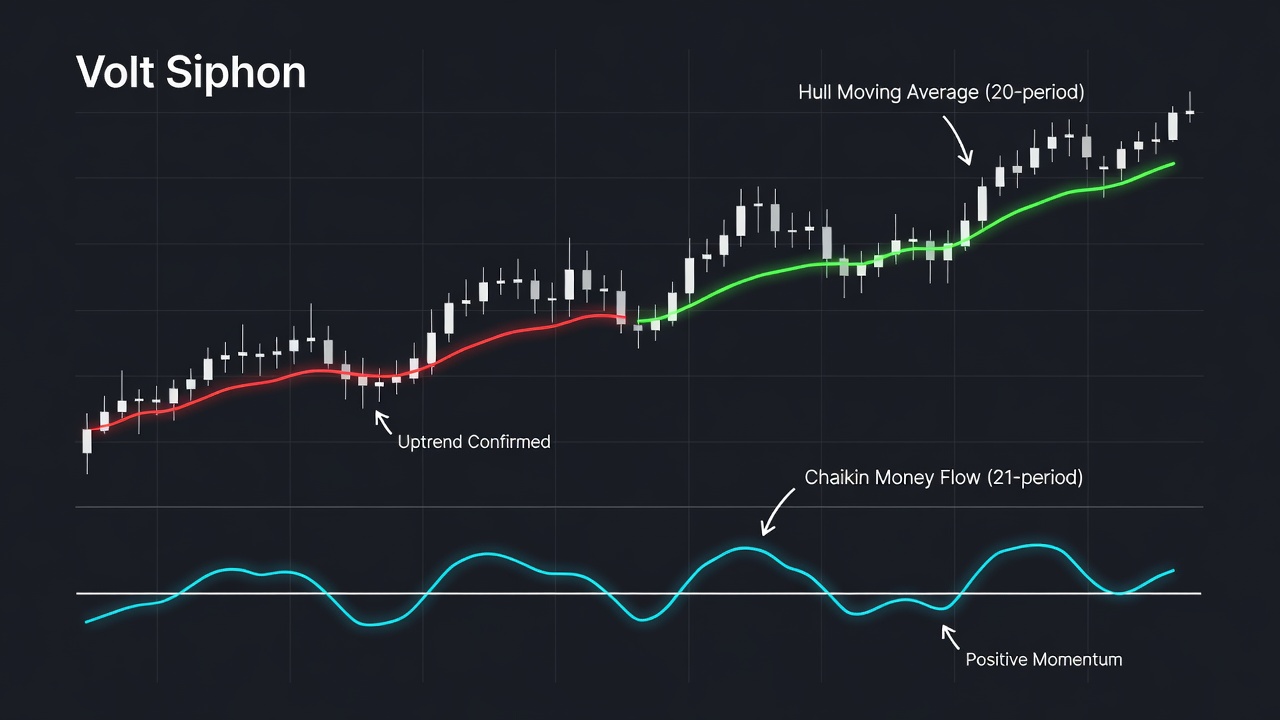
What Is The Volt Siphon?
The Volt Siphon is a multi-indicator momentum breakout system designed to catch the explosive acceleration phase of a trend. It exploits the transition from low-volatility accumulation to high-volatility distribution by filtering out minor price noise and tracking heavy institutional capital flows. This strategy is highly optimized for active day traders and fast-paced swing traders working the 5-minute, 15-minute, or 1-hour charts across highly liquid markets like Forex, major crypto pairs, and index futures.
Indicators You Need
- Hull Moving Average (HMA) – 20 Period: This is our primary trend direction and momentum filter. The HMA solves the lag problem of traditional moving averages, changing color instantly (green for bullish, red for bearish) to keep you on the right side of the short-term trend.
- Chaikin Money Flow (CMF) – 21 Period: This indicator measures institutional buying and selling pressure by analyzing accumulation and distribution. We use the CMF to verify that a move has actual institutional cash behind it, rather than retail fluff.
- Market Structure (Swing Highs and Lows): No indicator can replace pure price action. We require a structural shift—specifically a Break of Structure (BOS) over a recent swing point—to validate our directional bias before we risk a single dollar.
While the Volt Siphon can be traded on any liquid instrument, it performs exceptionally well on the 15-minute chart during high-volume trading sessions, such as the London and New York sessions.
The Volt Siphon Rules — Step by Step
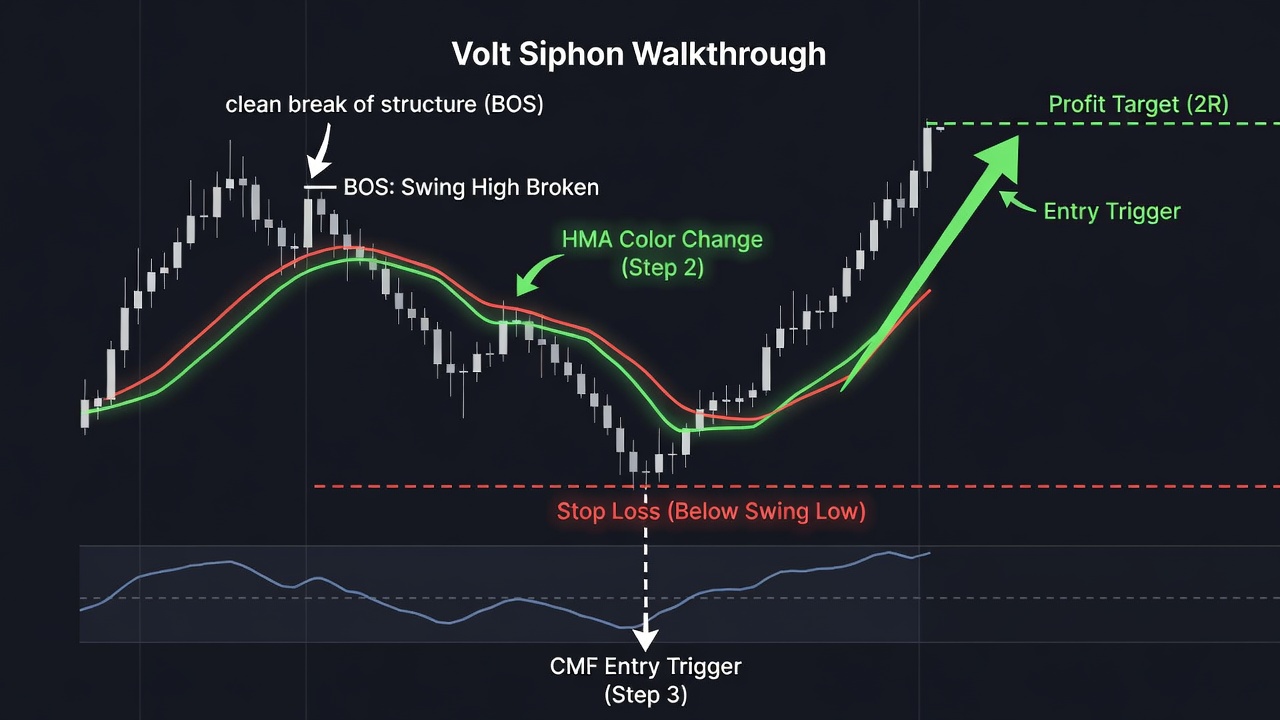
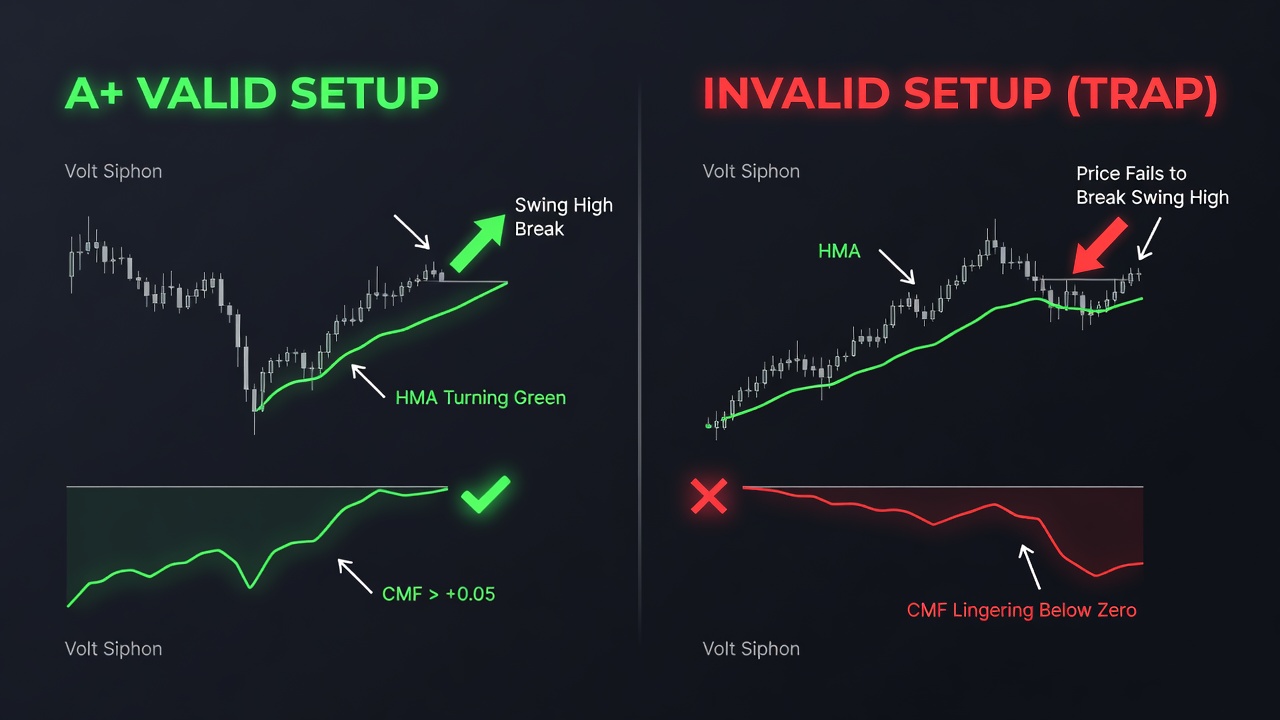
- Step 1: Trend and Structure Alignment: Identify the current market structure by locating the most recent swing high and swing low on your chart. For a long setup, you must observe a clear Break of Structure (BOS) where price closes above the most recent swing high. Simultaneously, the 20-period Hull Moving Average (HMA) must be colored bright green, proving that short-term momentum is in perfect alignment with the structural breakout.
- Step 2: Volume Confirmation: Look down at the 21-period Chaikin Money Flow (CMF) window. The CMF must be printing a value greater than +0.05. This numeric threshold ensures that there is significant buying pressure and real volume backing the breakout, weeding out low-liquidity spikes that lead to painful fakeouts.
- Step 3: Entry Trigger: Enter the market immediately at the close of the candle that satisfies both conditions: a closed candle above the previous swing high with the HMA green, and the CMF confirming at +0.05 or higher. Both conditions must be met on the same candle close to trigger the entry execution.
Entry, Stop Loss & Profit Target
Precision execution is what separates profitable traders from accounts that bleed out. To trade the Volt Siphon profitably, you must apply mechanical risk parameters to every trade. Here are the exact execution rules for a long trade (reverse them for short setups):
- Entry Price: Market buy at the exact second the setup candle closes, provided all Step 1, 2, and 3 criteria are perfectly met. Do not front-run the close or chase a runaway candle.
- Stop Loss Placement: Place your stop loss 2-3 pips/ticks below the most recent swing low prior to the breakout. If the swing low is excessively deep (making your risk too wide), place the stop loss just below the lowest point of the last three candles. This protects your capital if the breakout instantly fails.
- Profit Target: Set your take-profit target at a strict 2.0x multiple of your risk (1:2 Risk-to-Reward ratio). This ensures that even with a 45% win rate, your trading account remains highly profitable over any meaningful sample size.
Common Mistakes to Avoid
- Chasing Overextended Candles: If the breakout candle is massive and closes far away from the 20 HMA, skip the trade. Entering near the top of an overextended move exposes you to immediate pullbacks that will hit your stop before the trend resumes.
- Ignoring CMF Thresholds: Many traders enter simply because the HMA turned green and price broke structure, ignoring the CMF. If the CMF is below +0.05 (or above -0.05 for shorts), there is no institutional volume. Do not trade low-volume moves.
- Trading During Low-Liquidity Sessions: The Volt Siphon relies on explosive momentum. Trading this strategy during the Asian session doldrums or mid-day lunch hours leads to frequent whipsaws. Stick strictly to high-volume hours.
- Moving the Stop Loss to Breakeven Too Fast: Let the trade breathe. Moving your stop loss to breakeven the moment price moves 1R in your direction will result in getting stopped out prematurely on normal pullback structure.
Quick Reference Checklist
- Has a clear Break of Structure (BOS) occurred on the current timeframe? (Yes/No)
- Is the 20-period Hull Moving Average (HMA) showing the correct color for the trend direction? (Yes/No)
- Is the 21-period Chaikin Money Flow (CMF) reading above +0.05 (for longs) or below -0.05 (for shorts)? (Yes/No)
- Has the signal candle officially closed on your chart? (Yes/No)
- Is the breakout candle a healthy size, rather than an overextended, exhausted move? (Yes/No)
- Is the trade being taken during highly liquid market hours (London/New York)? (Yes/No)
- Have you calculated your position size based on a defined risk level below the swing low? (Yes/No)
Frequently Asked Questions
Q: Can I use a Simple Moving Average (SMA) instead of the Hull Moving Average?
A: No. The SMA reacts too slowly for this system. The entire edge of the Volt Siphon relies on the rapid responsiveness of the Hull Moving Average to filter out immediate momentum shifts. Using an SMA will cause you to enter trades late, destroying your risk-to-reward ratio.
Q: What should I do if the CMF is positive but below +0.05?
A: You must stay out of the market. A CMF reading between 0.00 and +0.05 indicates weak buying interest. The +0.05 filter is your primary defense against retail bull traps; ignore it at your own peril.
Q: Does this strategy work on daily charts?
A: Yes, the Volt Siphon rules scale beautifully to daily charts for swing trading. The only adjustment is that you must be prepared to hold trades for days or weeks, and you should ensure you do not hold positions through major earnings releases or high-impact macroeconomic announcements.
🎯 Get High-Probability Trade Setups — Free
The Big Dipper Dashboard delivers curated trade ideas straight to your screen every morning. Know what to watch before the opening bell.

📈 Want More? Join Our Free Trading Community
- Trading Strategy Guides Telegram — daily strategy tips and market insights
- Find Better Trades Telegram — free trade signals delivered to your phone
- Find Better Trades on YouTube — live trade breakdowns and tutorials

