Trading Crude Oil Futures with ICT Bearish Order Blocks in Volatile Markets

When geopolitical tensions erupt and supply shocks dominate the headlines, crude oil becomes a highly volatile battleground. While retail traders chase breakout rallies at the worst possible moments, institutional money leaves distinct footprints on the chart before driving prices lower. The ICT Bearish Order Block strategy on Crude Oil allows you to exploit these institutional footprints, offering precise entry parameters with tight risk parameters when the rest of the market is in a frenzy.
What Is an ICT Bearish Order Block?
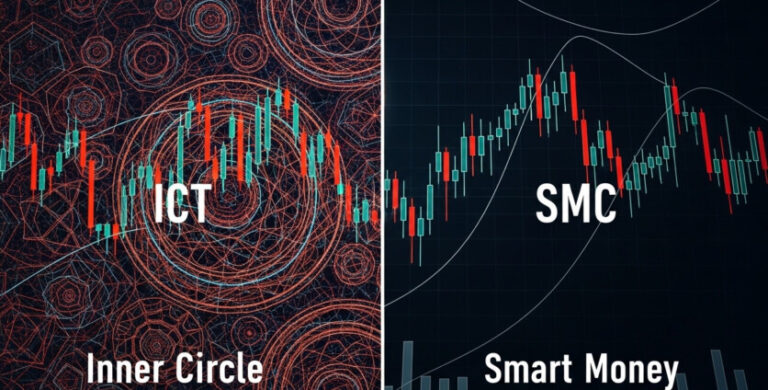
An ICT Bearish Order Block is the consecutive green (up-close) candles before a sharp, aggressive downward displacement that breaks market structure. Developed by Michael J. Huddleston, the founder of the Inner Circle Trader (ICT) methodology, this pattern represents the zone where institutional market participants heavily built up short positions. When price eventually retraces back up to this zone, these institutional traders mitigate their remaining positions, causing price to aggressively reject and resume its downward trajectory.
Why This Edge Works
During geopolitical crises, supply scares push crude oil prices to artificial highs. Retail traders succumb to FOMO (Fear of Missing Out) and buy at the absolute top of the range. Smart money exploits this pool of retail buy stops to build massive short positions. Because institutional orders are too large to fill all at once, they trigger a sudden price drop, leaving a trail of unfilled short orders. The initial sharp drop forms the bearish order block. When price retraces back to this block, it is not a sign of bullish strength; it is a search for liquidity. Smart money mitigates their remaining orders at this premium price level, fueling a second, rapid leg down that catches retail traders off guard.
The Setup Rules
- Timeframe Alignment: Identify the overall market bias on the 4-Hour or 1-Hour chart, then drill down to the 15-minute or 5-minute chart to identify the setup and execute the trade.
- Liquidity Sweep: Price must first sweep a pool of buy-side liquidity, such as a previous session high, previous day high, or equal highs, during an established ICT Killzone (London or New York session).
- Displacement and BOS: Look for a sharp, aggressive downward price movement that leaves consecutive red candles with large bodies. This displacement must break a prior swing low, creating a clean Break of Structure (BOS).
- Locate the Order Block: Identify the consecutive up-close (green) candles that immediately preceded that aggressive displacement. This candle cluster is your Bearish Order Block.
- Premium Pricing: Draw a Fibonacci retracement tool from the swing high of the sweep to the swing low of the displacement. The Bearish Order Block must reside within the Premium zone (above the 50% equilibrium level).
Entry Trigger
Your entry is triggered when price retraces upward into the lower boundary (the open or the mean threshold of the body) of the identified 15-minute Bearish Order Block.
Alternatively, for a conservative entry, wait for a lower-timeframe (1-minute or 3-minute) shift in market structure to occur inside the 15-minute order block before executing the short trade.
Stop Loss & Profit Target
Place your stop loss exactly 2-3 ticks above the highest wick of the Bearish Order Block to protect your capital from premature stop-outs. Target the nearest pool of sell-side liquidity, which typically resides at the recent swing lows, equal lows, or the previous session low. This strategy routinely yields a highly favorable 1:3 or 1:4 risk-to-reward ratio, meaning you can maintain a high level of profitability even with a moderate win rate.
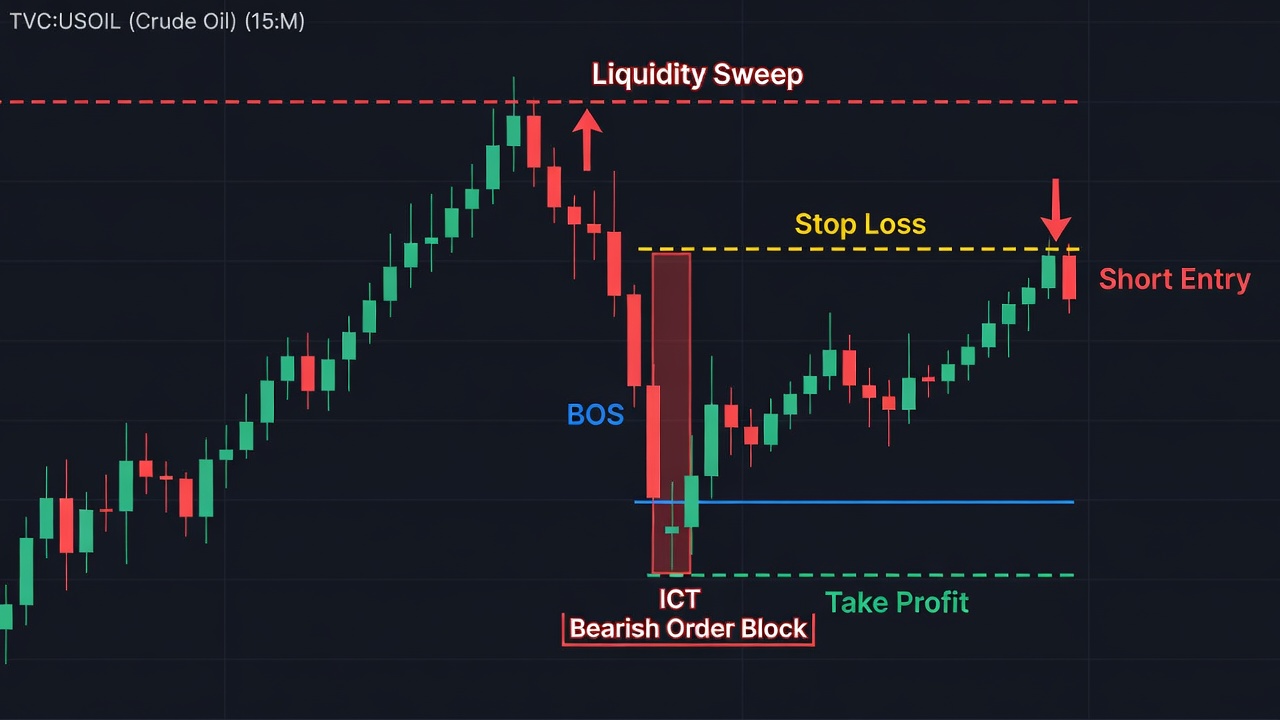
Trade Walkthrough: What It Looks Like on a Chart
As you can see in the chart above, TVC:USOIL was trading in a highly volatile environment during the New York session. First, the price rallied aggressively to sweep the previous London Session high, trapping breakout buyers who anticipated a geopolitical-driven breakout. Immediately after grabbing this liquidity, a massive institutional selloff occurred, resulting in three consecutive large-bodied red candles that broke the local swing low (BOS).
The last green candle before that drop was marked as our Bearish Order Block on the 15-minute chart. As the initial panic subsided, price retraced slowly back up into the premium zone, tapping the open of that designated order block. A short position was initiated immediately at $78.40, with the stop loss placed just above the block’s swing high at $78.85. The market rejected the zone instantly, selling off into the New York session low at $77.05, delivering a highly profitable, clean 3R trade.
Common Mistakes to Avoid
- Trading Outside Killzones: Avoid trading this setup during low-volume hours. Institutional order blocks require the volume and liquidity of the London or New York session opens to validate the moves.
- Ignoring Displacement: If the downward move after the liquidity sweep is slow, choppy, or lacks large-bodied candles, it is not true institutional displacement. Do not mark that zone as an order block.
- Trading in Discount Zones: Never enter a short trade if the order block lies below the 50% equilibrium level of the current swing range. You must sell at a premium.
- Chasing the Move: If the market drops aggressively and does not retrace to your designated order block, let the trade go. Chasing the market mid-move drastically ruins your risk-to-reward ratio.
Quick Reference Checklist
- Has price swept a clear key liquidity pool (session high, daily high, or equal highs)? [Yes/No]
- Did a sharp, displacement-driven break of structure (BOS) occur immediately after the sweep? [Yes/No]
- Is the identified Bearish Order Block situated in the premium zone (above the 50% retracement level)? [Yes/No]
- Is the setup taking place within the London (2:00-5:00 AM EST) or New York (7:00-10:00 AM EST) Killzones? [Yes/No]
- Is your stop loss placed safely above the highest wick of the Bearish Order Block? [Yes/No]
🎯 Get High-Probability Trade Setups — Free
The Big Dipper Dashboard delivers curated trade ideas straight to your screen every morning. Know what to watch before the opening bell.

📈 Want More? Join Our Free Trading Community
- Trading Strategy Guides Telegram — daily strategy tips and market insights
- Find Better Trades Telegram — free trade signals delivered to your phone
- Find Better Trades on YouTube — live trade breakdowns and tutorials