Ultimate Guide to Options Straddles on Oil ETFs During Geopolitical Crises

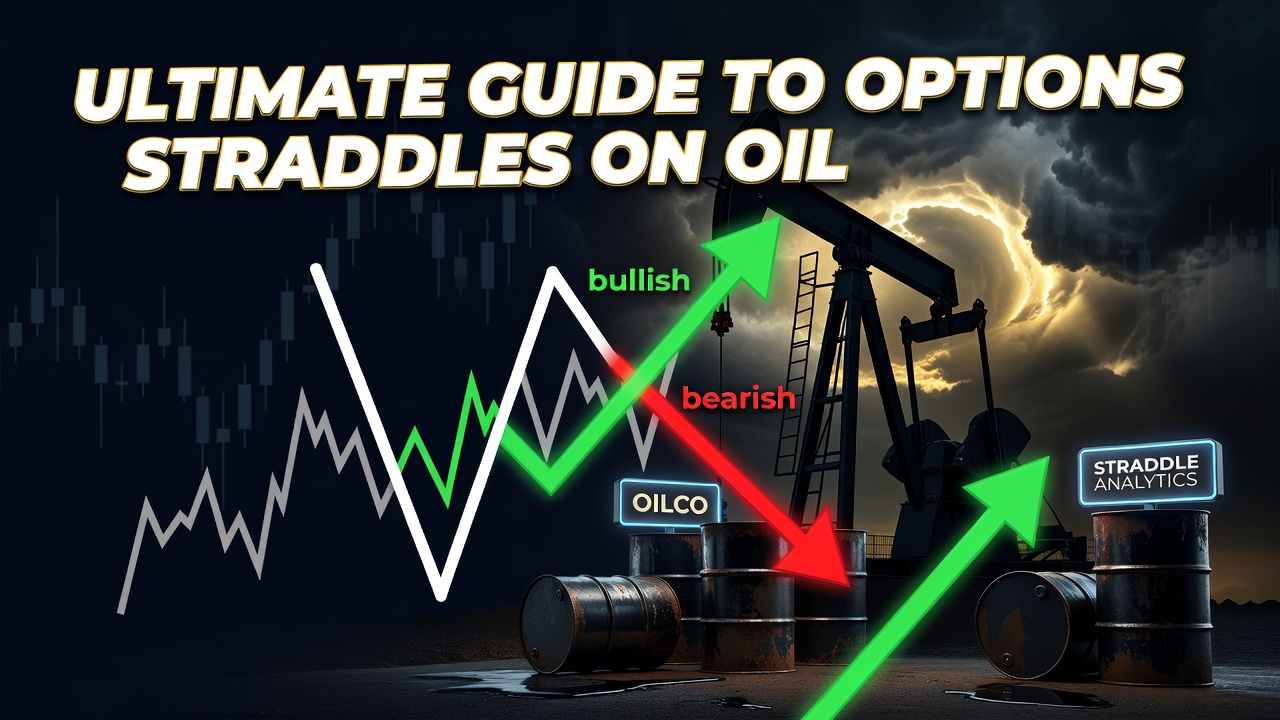
Geopolitical escalation in the Middle East creates massive, binary risk for crude oil. Instead of guessing whether supply disruptions will send oil to triple digits or diplomatic breakthroughs will crash the market, professional traders exploit the guaranteed expansion of volatility. The Long Options Straddle allows you to profit from explosive price moves in United States Oil Fund (USO) without needing to predict which way the market breaks. This strategy is built for active derivative traders who want to capitalize on high-tension news cycles where the only certainty is that the market will not stay still.
What Is an Options Straddle?
A Long Straddle is an options strategy where a trader simultaneously purchases an at-the-money (ATM) call option and an at-the-money put option for the same underlying asset, expiration date, and strike price. Originally popularized by floor traders looking to exploit mispriced premium ahead of major regulatory or supply decisions, the strategy relies entirely on a sharp rise in implied volatility or a massive directional price movement. Because you hold both a call and a put, the trade has unlimited profit potential to the upside, substantial profit potential to the downside, and strictly limited risk equivalent to the total debit paid to enter the position.
Why This Edge Works
The mathematical edge of a long straddle during geopolitical instability rests on two factors: the expansion of Implied Volatility (IV) and the underpricing of tail risk by market makers. During periods of relative calm, the options market prices USO with a low IV, making option premiums cheap. When unexpected military or diplomatic events occur, the sudden panic causes market makers to aggressively bid up options premium across all strikes to hedge their own risk. This expansion in IV increases the value of both your call and put options simultaneously, a phenomenon known as vega expansion. Furthermore, crude oil is prone to gapping. When a supply choke point is threatened, price moves exponentially, easily exceeding the break-even boundaries calculated by the option chain. You do not need to be right on the direction; you only need the market to move further than the market makers predicted when you bought the cheap volatility.
The Setup Rules
- Asset Selection: Focus exclusively on high-volume, liquid oil vehicles. The primary instrument is AMEX:USO due to its tight bid-ask spreads and highly liquid options chain. Avoid illiquid leveraged ETFs where wide spreads eat your edge.
- Volatility Filter: Calculate the 30-day Implied Volatility (IV) relative to its 1-year historical range. Only enter when IV Rank (IVR) or IV Percentile is below 35%. Buying straddles when IV is already at the 90th percentile means you are paying peak prices, risking an ‘IV crush’ even if the price moves.
- Consolidation Identification: The underlying asset must be trading in a tight, defined horizontal range for at least 7 to 10 trading days. This consolidation indicates coiled energy and compressed realized volatility.
- Expiration Selection: Select an expiration cycle between 30 and 45 days to expiration (DTE). This sweet spot provides enough time for the geopolitical catalyst to play out while avoiding the rapid accelerating decay of extrinsic value (theta) that occurs in the final 14 days of an option’s life.
Entry Trigger
Buy 1 ATM Call and 1 ATM Put at the identical strike price (closest to the current spot price of USO) when the price touches the center of the consolidation range on a Friday afternoon before a highly anticipated weekend geopolitical decision or when the daily ATR (Average True Range) drops to a 20-day low. Alternatively, enter the trade immediately when the 10-day realized historical volatility drops below the 30-day implied volatility, signaling that the options market has underpriced the coming breakout.
Stop Loss & Profit Target
Unlike standard stock positions, a straddle stop loss is managed based on a percentage of the premium paid rather than a specific chart level. Set a hard exit rule to sell both legs of the straddle if the total value of the position depreciates by 30% of the initial debit paid, which protects you against unexpected consolidation. Set the primary profit target at 40% to 50% return on the total premium invested. The mathematical risk/reward profile is asymmetric; your risk is capped at the debit paid (1R), while a successful breakout can easily return 2R to 3R of your risked capital as the winning leg goes deep into-the-money and delta approaches 1.00.
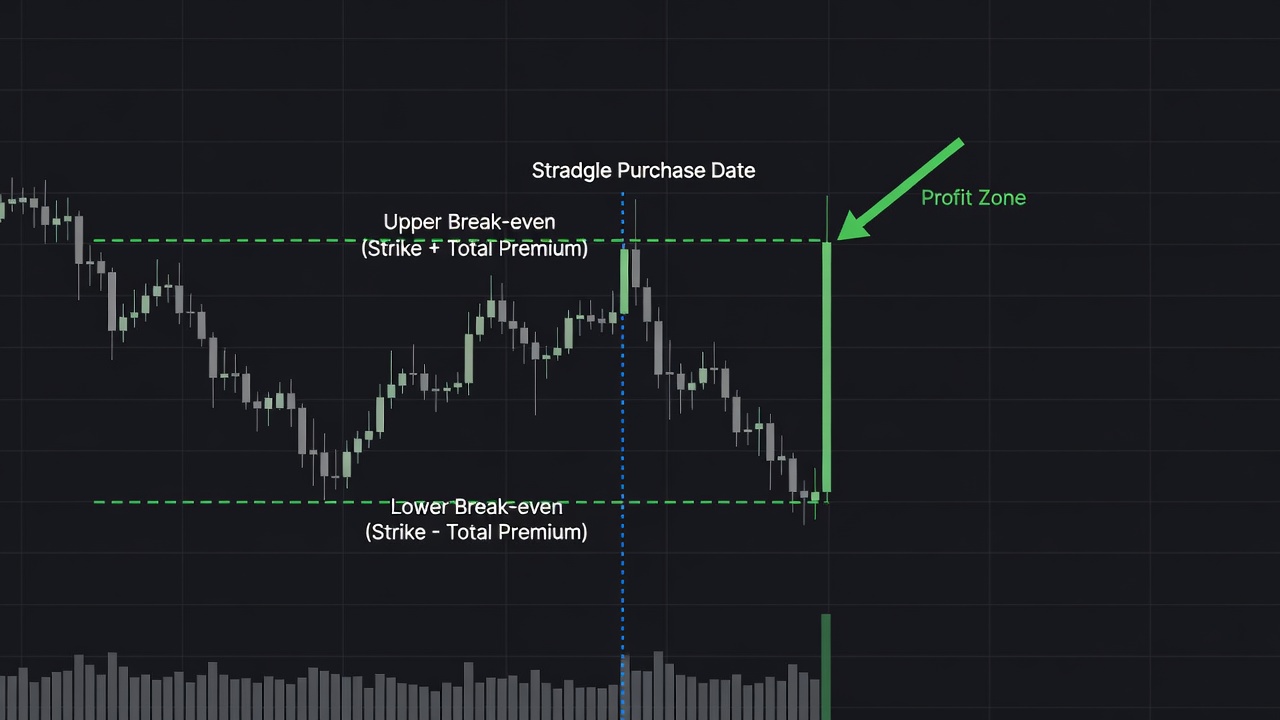
Trade Walkthrough: What It Looks Like on a Chart
As you can see in the chart described above, USO enters a prolonged period of low-volatility consolidation, winding tightly between $70 and $72 over a two-week period. During this time, escalating rhetoric in the Middle East has calmed temporarily, causing the IV Rank of USO to drop to a cheap 18%. This is the perfect environment for setup deployment.
With USO trading exactly at $71 on a Thursday afternoon, you execute the entry trigger. You purchase the 35-day out $71 Call for $2.10 and the $71 Put for $1.90. Your total debit paid (risk) is $4.00 per straddle ($400 total per contract). This places your upper break-even level at $75.00 ($71 strike + $4.00 premium) and your lower break-even level at $67.00 ($71 strike – $4.00 premium).
Three days later, hostilities break out, and crude supply fears dominate the news. On Monday morning, USO gaps open at $76.50 and rapidly climbs to $79.00. The $71 Put is now virtually worthless, trading near $0.05. However, the $71 Call has exploded. With USO at $79.00, the call has $8.00 of intrinsic value, plus an additional $1.20 of extrinsic value fueled by the skyrocketing Implied Volatility, which has surged from 18% to 65%. You sell the entire straddle (both legs) for a combined price of $9.25. Subtracting your initial $4.00 debit, you capture a clean net profit of $5.25 per contract ($525 profit on a $400 risk), yielding a 131% return on risk in just days.
Common Mistakes to Avoid
- Buying High IV: Entering the straddle after the geopolitical news has hit the tape and oil has already spiked. At this point, option premiums are bloated, and you will lose money on an IV crush even if the price keeps moving.
- Holding Too Close to Expiration: Keeping the position inside of 10 DTE. Theta decay accelerates exponentially during this window, eroding your premium daily and making it incredibly difficult to turn a profit.
- Legging Out Early: Selling the profitable side of the trade while holding onto the losing side hoping for a reversal. This ruins the mathematical hedge of the strategy. Always manage the straddle as a single, unified position.
- Ignoring Bid-Ask Spreads: Executing trades during low-liquidity hours or in illiquid strike prices. Slippage on two legs simultaneously can destroy up to 10% of your potential profit on entry and exit.
Quick Reference Checklist
- Is the underlying asset a highly liquid oil vehicle like USO? (Yes/No)
- Is the IV Rank or IV Percentile of the underlying asset currently below 35%? (Yes/No)
- Has the underlying asset been consolidating in a tight trading range for at least 7 days? (Yes/No)
- Are you choosing an options expiration cycle between 30 and 45 days to expiration? (Yes/No)
- Are you purchasing both the Call and Put options at the exact same strike price and expiration date? (Yes/No)
- Have you set a hard stop loss to exit the entire position if the total premium value drops by 30%? (Yes/No)
🎯 Get High-Probability Trade Setups — Free
The Big Dipper Dashboard delivers curated trade ideas straight to your screen every morning. Know what to watch before the opening bell.

📈 Want More? Join Our Free Trading Community
- Trading Strategy Guides Telegram — daily strategy tips and market insights
- Find Better Trades Telegram — free trade signals delivered to your phone
- Find Better Trades on YouTube — live trade breakdowns and tutorials